Skip to content

Blog

A post we never want to have to make!

An image showing the word "Sorry" with three exclamation marks

This is the post we never want to make, where we made errors with our previous ISO release and are having to take steps to fix the issue, including releasing an updated ISO.

Over the course of April, the team worked on systemd-presets as a workstream we didn’t actually talk about in our April blog post. We thought that all the work had been completed in such a fashion that users wouldn’t see any discernible difference whilst allowing us to move closer to “best-practice” approaches.

Unfortunately, due to the way systemd functions, it doesn’t natively support a global preset-all approach on first boot, one of the preset approaches we had recently adopted. In combination, our lichen installer was creating an /etc/machine-id file in new installs, which is what systemd uses to detect whether a machine is in its first boot or not.

As such, users on existing systems did not have an issue, but new installs could be broken and we did not detect this as part of our ISO testing process.

Thanks to user feedback, we were able to narrow down, identify and resolve the issue within 24 hours of the ISO release, and we had an updated ISO up for testing within our server by the end of the first day of the original release. The fix came via two commits:

  1. Lichen: Fix first boot
  2. Systemd: Preset-all user services on first-boot

Following additional testing with a wider audience on our Zulip server, we have updated the links on our download page to our new ISO so any users downloading the latest ISO won’t see these issues.

How we view the project and our roles in creating it

Section titled “How we view the project and our roles in creating it”

Since taking over stewardship of AerynOS last year, we have consciously reset our own expectations of what we aim to deliver to our users / early adopters. It is a deliberate decision to keep the distro at an alpha tag, as there are certain expectations / deliverables for our core tooling we have not yet met.

We know we haven’t publicly laid out our roadmap, another deliberate decision, but this is all in service of delivering a product that early adopters (and eventually users) can rely on without having to worry about “what the hell might go wrong”.

There is an ethos within the team that we take seriously our craft, that being to create new and modern tooling that will make delivering and maintaining a Linux distribution significantly easier and more ergonomic.

In retrospect, we’re glad that in the year that we have collectively had stewardship of the project, this is the first and only time we have had to rush out a new ISO to fix an issue. We hope to not have this occur again in the future.

In the background, we have been offering a “best effort” approach to supporting NVIDIA GPUs. This is primarily because nobody on the core team are actually using NVIDIA GPUs, and because NVIDIA’s approach to open source leaves a lot to be desired from a package- and distro-maintenance point of view.

For an alpha tag distribution that is primarily focused on dogfooding itself, NVIDIA GPU support has been — and remains — fairly low priority.

That said, Reilly identified an issue with our build ordering that caused the NVIDIA module to fail to work for GPUs that require GSP firmware. With this knowledge, we have implemented a manual fix for now. The underlying issue was already known to the team, we just hadn’t caught that it presented an issue for this particular case. Fixing that issue in our infrastructure tooling is therefore moving up on our list of priorities.

The issue with new installs only presented because of our new ISO release. Had users installed AerynOS from any of our previous ISOs, the distribution would have installed without issue. Last year, we made a decision to move to a monthly ISO cadence as part of a wider “hearts and minds” effort, to demonstrate that AerynOS is in good hands, and that we are able to consistently deliver progress at a time when there was uncertainty of whether the project would be able to survive during Ikey’s initial (and, as it turned out, eventually permanent) absence from the project.

However, as a rolling release distro with a net-installer, it doesn’t strictly matter which ISO you boot to install AerynOS on your system (or in a VM), given that Lichen will always install from the latest unstable stream version of AerynOS. As such, we are reviewing our release cadence and will likely align releases around a couple of key factors:

  1. Major Linux kernel versions for new hardware support
  2. Updates to our installer

which will also have a benefit of reducing bandwidth consumption. This won’t however affect the frequency of our blog posts, as we have found it helpful to communicate often with those following along with the project.

We actually delivered quite a lot in the last couple of days!

Section titled “We actually delivered quite a lot in the last couple of days!”

Package / stack updates for this iteration include:

Updates:

  • linux stable & gaming 7.0.3
  • linux LTS 6.18.26
  • thunderbird 150.0.1
  • asciinema 3.2.0
  • enchant 2.8.16
  • faugus-launcher 1.18.10
  • flatpak 1.16.6
  • glib2 2.88.1
  • gtk-4 4.22.4
  • inetutils 2.8
  • libvirt 12.3.0
  • rssguard 5.1.0
  • wine 11.8

Fixes:

  • boulder: Ensure that failing to set thread priority to SCHED_BATCH does not cause a panic w/ backtrace.
  • nm-connection-editor: It’s now a separate package and can be installed without networkmanager-applet
  • strawberry: Fixed not supporting common audio formats

Added:

  • envision 3.2.0 (VR gaming)
  • gitui: A graphical git client
  • hexyl: A terminal based hex viewer with coloured output
  • pkgset-oxidize: A set of pkgsets for different WM environments designed to work with the oxidize theme tool
  • oxidize: A tool for atomically changing themes in supported WMs
  • yt-dlp 2026.03.17

One of our community members, Christian Bendiksen, has been working on automated theming of window managers over the last couple of months with his oxidize tool.

His work is now ready to be included in AerynOS, and can be used to automate theme setup for the four window manager options we have within AerynOS. There are many popular themes already included, and Christian has taken the initiative to play around with our new brand colour palette to make a new Aeryn theme as well!

This work builds on top of the great work Christian and a number of other dedicated contributors have been putting in to build out AerynOS’ Window Manager credentials with the inclusion of packages to bolster our offering in this area. Taking this further, Christian has also created a package set around oxidize. This package set will help simplify the process of getting set up with a great Window Manager configuration without having to go through all of the steps to get there. The next step is to take this further by utilizing our system-model approach to further develop this approach with the goal being to eventually have a simple preconfigured Window Manager option available out of the box.

Of course, for those wishing to configure their Window Manager experience from scratch, this option is of course available to you as well.

With this blog post, we already have a new 2026.05.2 ISO available on our download page.

It incorporates all the changes and package updates highlighted above and as usual, serves as a vessel for you to use lichen to install AerynOS onto your system or into a virtual machine.

The primary focus on the development side is (still) to attempt to get the Versioned Repos, phase2 feature over the finish line as soon as feasible.

Frankly, we have been so focused on getting the Versioned Repos, phase2 feature right, that we’ve scarcely had the mental bandwidth to focus on anything else from the perspective of our larger development arc.

That said — and assuming we succeed in landing the Versioned Repos, phase2 feature soon — we will then spend some time on sketching out the details of the upcoming avenues of development that will open up as a result.

In parallel to that, we hope to spend some time getting our systemd-preset story straight from a packaging perspective, which will give us the ability to enable services as a packaging operation. This will be especially useful when leveraged via our declarative system-model capabilities.

Outside of financial donations through Stripe and Ko-fi mentioned above, we are always looking for people to get involved with development and packaging efforts and welcome anyone curious about AerynOS to join us in our Zulip server!

If any hardware vendors are interested in sponsoring the project either financially or through hardware sponsorship, this would be warmly received.

If you wish to discuss other sponsorship opportunities, such as hosting or hardware sponsorship, please reach out to us at contact@aerynos.com.

We are very grateful for your support, be it financial or via project contributions in the form of carefully written bug reports, code contributions, design contributions, documentation updates, general feedback, package updates and overall enthusiasm around the project.

We hope that you will continue showing enthusiasm for our project, and that you will want to get involved in whichever way, shape, or form works for you!

Rebranding, Upgrading, and Wallpapering: AerynOS’ April glow-up!

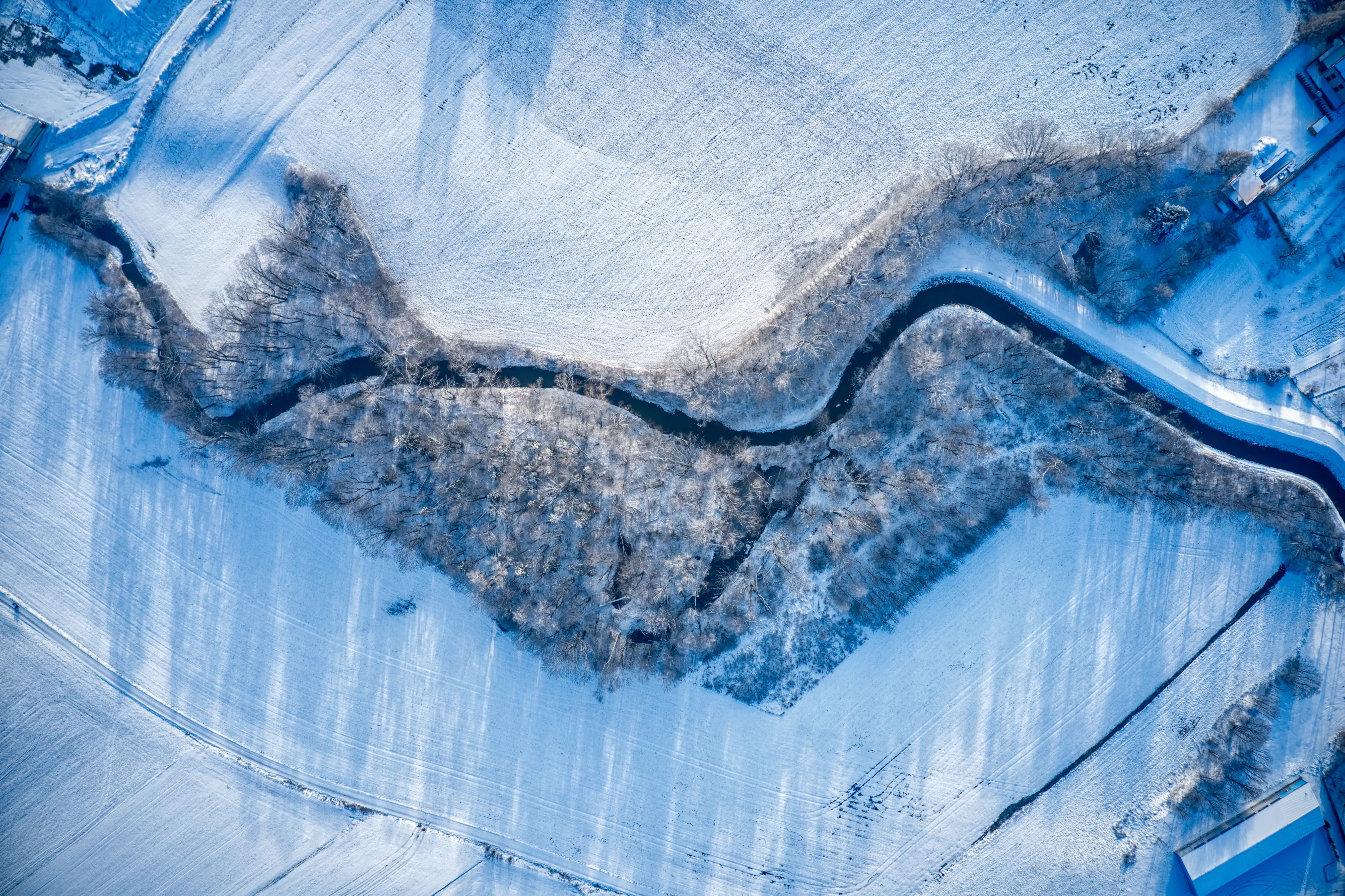
Image captured by a drone camera of wintery snowy fields with a river meandering through the middle

No, this isn’t a suspicious phishing attempt! AerynOS has officially gone through a rebrand 🎉

Over the course of April, we rolled out a new logo and refreshed colour palette across the entire project. It took a bit of time to thread this through every corner of the OS and our web presence, but we’re happy to say it’s now fully in place.

Alongside the new branding, we’ve also been collaborating with community member ziegenmelker5, licensing a selection of his photography for use as wallpapers (and the title image above). A handful of these have already landed in our artwork repository and will show up on user systems after the next sync. On top of that, the team has created an abstract wallpaper inspired by the new logo, so there’s a bit of something for everyone.

On the software development side, a big chunk of April was spent improving our core tooling, especially moss and boulder:

Boulder:

  • Added boulder cache size to show cache size of both boulder and moss.
  • Added boulder cache clean to free up space on system by deleting the cache.
  • Updated boulder recipe update to use ent to check for recipe updates and appropriately update the stone.yaml accordingly.

Moss:

  • moss state prune is now faster and shows a progress bar when removing states.

In addition, we’ve continued our reuse compliance work, extending it from our recipes repository into our os-tools repository. This brings us closer to full compliance across the board.

Lastly, we have expanded our kernel configurations and now offer an LTS, stable and gaming kernel, though switching away from the stable kernel isn’t yet a simple process.

Package / stack updates for this iteration include:

  • COSMIC DE 1.0.11
  • GNOME 50.1
  • KDE Frameworks 6.25.0
  • KDE Gear 26.04.0
  • KDE Plasma 6.6.4
  • dankmaterialshell 1.4.6
  • dash 0.5.13.3
  • docker 29.4.1
  • eza 0.23.4
  • firefox 150.0.1
  • fresh 0.2.23
  • jujutsu 0.40.0
  • kitty 0.46.2
  • kmscon 9.3.5
  • linux-gaming 7.0.2
  • linux-lts 6.18.25
  • linux-stable 7.0.2
  • llvm 22.1.4
  • ly 1.3.2
  • maven 3.9.15
  • mesa 26.0.6
  • niri 26.4
  • ntpd-rs 1.7.2
  • openvpn 2.7.2
  • pipewire 1.6.4
  • qemu 11.0.0
  • python 3.14.4
  • rust 1.95.0
  • thunderbird 150.0
  • uutils-coreutils 0.8.0
  • wine 11.7
  • zig 0.16.0
  • zls 0.16.0
  • zed 1.0.0

… along with sundry additions and updates.

boulder cache subcommands with clean and size options

Section titled “boulder cache subcommands with clean and size options”

Screenshot showing boulder cache size command with output

This month, Joey has added additional subcommands for boulder to calculate cache sizes (both for boulder and moss). Additionally, a boulder cache clean command was added that will delete the cache to help free up space on a user’s system.

This will be particularly helpful for our packagers who after building packages will have increasing amounts of space taken up by the boulder cache. The team itself frequently moves between our unstable and volatile repositories so having the ability to delete the moss cache will also be helpful to ensure predictable outcomes.

Screenshot of a terminal session after running boulder recipe update on the yq package recipe, resulting in the automatic update of the corresponding stone.yaml recipe file

Using our self built ent tool (which integrates with Anitya for release monitoring), we’ve taken another step toward automating package maintenance by combining it with our boulder recipe update command. When invoking this command, boulder will:

  • Check for updates using ent
  • Resolve the source URL of the latest update
  • Download the latest version source archive
  • Appropriately update the stone.yaml recipe

…all in one go.

There’s also JSON output support, which will be useful as we expand our automation tooling further down the line.

For simple package updates, this helps consolidate some of our mundane workflow steps and help make packaging a more streamlined affair on AerynOS, letting packagers focus on logic and problem solving, not administrative minutiae.

Screenshot of a terminal session after running sudo moss state remove 56-77, resulting in a confirmation prompt and log of the deleted state directories

State removal is now faster thanks to parallelization, and it finally provides real-time feedback via a progress bar.

Behind the scenes, moss intelligently handles our deduplicated CAS storage, which is why removal order might look a little unusual, it’s working out which files are safe to delete across shared states.

A new contributor, otherJL0, has made some great improvements to our moss search command:

  • Support for using provider syntax in search, e.g. sysbinary(...)
  • Smarter grouping of results based on name or summary
  • Highlights matched substrings in output by name or summary

This is especially useful for packaging workflows as our packagers can get a better understanding of which packages provide a given binary or library.

Continuation of our Versioned Repository feature set

Section titled “Continuation of our Versioned Repository feature set”

We’ve continued work on phase 2 of our Versioned Repositories feature, and a draft PR with the basic workflow and new configuration format has been opened for moss. The vessel repository manager companion work has been mapped out, but no PR has yet been opened for this.

As mentioned in previous posts, the key goal of phase 2 is to enable moss to upgrade itself seamlessly, which in turn enables us to add support for new repository features and .stone format features without manual intervention.

In practical terms, this moves us closer to a true install-once, update-forever model, where we can evolve the capabilities of the system over time, without leaving users on older moss versions behind.

We hope to land the phase 2 related feature PRs in the near future.

April was a big month for us here at AerynOS, as we made some exciting strides in our rebranding efforts. We’re thrilled to finally roll out a brand-new logomark, a version of the triquetra that was originally proposed by community member Petru Jenach, and later refined by community member platlas when AerynOS was rebranded from SerpentOS last year.

Working closely with platlas and the wider community, we’ve spent the last few months refining the design and selecting a brand new colour palette. Special thanks to sammypanda, who suggested the colour scheme that we ended up using.

So, what’s behind the triquetra? This symbol has deep meaning across cultures, but we’ve chosen it particularly for its Irish roots, as a nod to AerynOS’ founder, Ikey Doherty. The triquetra represents themes of life, death, and rebirth, which felt fitting for a project that’s always evolving. It also symbolises unity and commitment, values that align with our community driven approach.

Design-wise, we’ve divided the three points of the triquetra into two colours: green and orange. The green is all about nature, while the orange ties directly to Rust, the programming language at the heart of our project. We love how the orange section can be interpreted as an ‘O’ and the green section as an ‘S’, coming together to form “OS”. It’s subtle, but we think it’s a nice touch.

We’re really excited about this fresh new look, and the fact that it’s something the whole community helped us shape. We’ve spent the month rolling it out across the operating system and our web presence, and we’re happy with how it all ties together.

New Wallpapers: Bringing Nature to Your Desktop

Section titled “New Wallpapers: Bringing Nature to Your Desktop”

Screenshot of a newly installed virtual machine instance of AerynOS, Gnome edition showing the about this system page with the new default AerynOS wallpaper

Next to the new logomark, we’ve also worked with community member Gabriel Janich (aka ziegenmelker5) to bring some stunning new wallpapers to AerynOS. Gabriel has an amazing collection of photos, and choosing just a handful to feature was no easy task!

In the end, we selected seven that we felt best represented the spirit of AerynOS. You’ll see two of them as the new default wallpapers for Cosmic and GNOME (we have some work to do to properly customise our KDE Plasma defaults). Each one has its own vibe, but all of them bring a touch of nature and tranquility to your desktop.

We hope these new wallpapers, paired with the fresh logo, help make your AerynOS experience even more enjoyable as you dive into the project in the coming days and months.

Screenshot of a newly installed virtual machine instance of AerynOS, Cosmic edition showing the about this system page with the new default AerynOS wallpaper

We mentioned last month that we planned a Python stack upgrade. Due to diligent prior preparation work by Reilly, this stack upgrade landed in a fairly seamless manner with only minor fixes required over the course of a day. The process saw Python being upgraded from 3.11 to 3.14.4 as of this writing.

Our python stack isn’t currently very large (only around 200 packages) which also played a role in the fairly seamless nature of this update. From what we can tell, the updated has enabled our early adopters to continue using Python packages without any regressions.

We have packaged two alternative kernel options, though we have yet to finish the supporting work required to let users easily switch between them:

  1. linux-lts (6.18): Latest LTS release for our most stable offering.
  2. linux-stable (7.0): Follows the latest stable release with very few optimisations for a current stable offering.
  3. linux-gaming (7.0): Also follows the latest stable release, but with patches for handheld gaming and miscellaneous performance optimisations.

Switching away from our linux-stable kernel to either of the other two alternative options isn’t a smooth process just yet. Improving that experience is on our roadmap.

We are releasing our newest Alpha ISO, AerynOS 2026.05, which includes the updates we’ve worked on since the start of April, and which features the 7.0.2 linux-stable kernel.

As usual, this is a Live GNOME ISO that merely serves as a delivery vehicle for our Alpha/PoC lichen installer. Hence, installing AerynOS requires a network connection over which the latest pkgsets can be downloaded and subsequently installed onto a hard drive.

Please note that for now, Ventoy cannot be used to install AerynOS ISOs for which we have submitted a bug report upstream. Not to worry, multiple other options work such as Etcher, DD and GNOME Disks.

The link for our 2026.05 ISO can be found on our download page.

The primary focus on the development side is to attempt to get the Versioned Repos, phase2 feature over the finish line as soon as feasible.

Frankly, we have been so focused on getting the Versioned Repos, phase2 feature right, that we’ve scarcely had the mental bandwidth to focus on anything else from the perspective of our larger development arc.

That said — and assuming we succeed in landing the Versioned Repos, phase2 feature soon — we will then spend some time on sketching out the details of the upcoming avenues of development that will open up as a result.

In parallel to that, we hope to spend some time getting our systemd-preset story straight from a packaging perspective, which will give us the ability to enable services as a packaging operation. This will be especially useful when leveraged via our declarative system-model capabilities.

Over the last year, the project has been through a significant period of change. As detailed in our October 2025 blog post, we had to update our sponsorship accounts to receive future sponsorship funds once it became clear our previous project leader had permanently stepped away from the project.

This left us in a position where we had to build up our sponsor income from scratch having lost previous sponsors. We are very grateful that many sponsors (old and new) have joined or stayed with us on this journey and our income is again able to cover our fixed project costs with a little surplus each month.

As of this month, we are now in a net neutral position having borne the project costs for a year whilst receiving sponsorship income for 6 months. We are very appreciative of all who have ever sponsored the project, we wouldn’t be here without your support! ❤️

Ideally we would like to grow our monthly income (and therefore surplus). Doing so would allow us to:

  1. Support our staff who currently work without compensation (apart from occasional hardware donation)
  2. Scale and/or upgrade infrastructure over time
  3. Consider purchasing hardware for compatibility testing
  4. Fund future initiatives for the betterment of the project

If you wish to discuss other sponsorship opportunities, such as hosting or hardware sponsorship, please reach out to us at contact@aerynos.com.

We are very grateful for your support, be it financial or via project contributions in the form of carefully written bug reports, code contributions, design contributions, documentation updates, general feedback, package updates and overall enthusiasm around the project.

We hope that you will continue showing enthusiasm for our project, and that you will want to get involved in whichever way, shape, or form works for you!

March 2026 project update

Climbing

Another month brings another project update. In some respects, March has felt somewhat quieter than usual for the project. However, in the background, things have been fairly busy on the development front, as we prepare for larger and more visible tooling updates to land in the months to come.

On the packaging front, notable package & stack updates include GNOME 50, KDE Plasma 6.6.3, LLVM 22.1.1, Wayland 1.25.0, QT6.11.0, FFmpeg 8.1 and mesa 26.0.3 which have kept our builders busy with a significant number of package builds and rebuilds. The team mentioned last month that there is a soft-freeze in place for our repository, in terms of accepting new package recipes. This is not a full freeze as packages with little or no reverse dependency rebuild chains are still being accepted where we believe they will prove useful.

The development work this month has centered around the features we offer in terms of automating recipe updates and how we can better support bootstrap builds on the boulder side, along with the usual clean-up and refactoring work across the moss and boulder code bases.

Lastly, we want to take a moment to thank Framework for their on-going hardware sponsorship of our project. This month, they have provided the project with an AMD AI 300 based Framework 16 that Joey Riches is now using as a dedicated device for AerynOS development.

Package / stack updates for this iteration include:

  • GNOME 50.0
  • KDE Frameworks 6.24.0
  • KDE Gear 25.12.3
  • KDE Plasma 6.6.3
  • awww 0.12.0
  • dankmaterialshell 1.4.4
  • firefox 149
  • fish 4.6.0
  • fresh 0.2.20
  • jujutsu 0.39.0
  • linux 6.18.19
  • mangowm 0.12.7
  • mesa 26.0.2
  • pipewire 1.6.2
  • qemu 10.2.2
  • riftbar 0.1.8
  • thunderbird 149.0.1
  • wine 11.5
  • dash 0.5.13.2
  • wlroots 0.19.3
  • wayland 1.25.0
  • maven 3.9.14
  • gparted 1.8.1
  • kitty 0.46.1
  • systemd 257.13
  • zls 0.15.1
  • sudo-rs 0.2.13
  • llvm 22.1.1
  • Qt6 6.11.0

… along with sundry additions and updates.

Gnome Install

This month sees a significant update to the GNOME stack with the delivery of GNOME 50. We have not received any reports of any issues but if you do find any bugs, please report them back to us via GitHub Issues or through our Zulip community.

Some key updates include:

  • Improved parental controls
  • VRR and Fractional Scaling are now stable and enabled by default
  • Wayland only, coming in line with AerynOS’ default of having no X11 session

Plus many more features and fixes.

KDE Install

KDE Plasma has been updated to 6.6.3, KDE Frameworks to 6.24.0 and KDE Gear to 25.12.3.

The latest KDE Plasma update brings:

  • KWin’s screencasting feature has become robust when using PipeWire 1.6 or newer
  • Reduced CPU and GPU load for full-screen windows for screens using more fractional scale factors
  • Improve support for mice with high-resolution scroll wheels in the built-in remote desktop server

Our packaging community has really taken to the Wayland Compositor Environment choice we have in AerynOS. With new packagers getting involved with AerynOS, we are seeing faster package updates and submissions for packages that specifically enhance people’s ability to rice their environments just the way they like them.

A few key updates this month include:

  • mangowm 0.12.7
  • dankmaterialshell 1.4.4
  • elephant 2.20.3
  • bluetui 0.8.1
  • impala 0.7.4
  • awww 0.12.0
  • riftbar 0.1.8

On top of this, several packages have been rebuilt for better performance, support or defaults. The default terminal in our Sway package set has been swapped from alacritty to foot as this is the default terminal proposed by Sway itself. Elephant has had upstream support for moss included and this version has now been added to our own repository. Niri has seen a few upstream improvements backported into our repository also.

As part of our content delivery strategy, we had already moved to using a CDN for delivering updates through moss on our Unstable repository. This month, we have made the transition to also using the CDN for our Volatile repository as well.

The Volatile repository is primary used for those who do their own packaging and/or submit packages to our repository. This change helps speed up downloads for those users as they disproportionately engage with our repositories for packaging purposes.

We have updated our documentation accordingly, so if you do any packaging work on AerynOS, please refer to the updated documentation on our dotdev site.

Moss searching has been updated to add the ability to search by binary provider.

Currently, the command line to do so is moss search --provides some-binary

Example:

$ moss search --provides cat
uutils-coreutils Cross-platform Rust rewrite of the GNU coreutils

The current implementation is somewhat limited, and work is ongoing to improve and generalize this functionality.

Moss works by utilizing a Content Addressable Storage architecture. This means that all package related files are stored in a deduplicated manner in the CAS and then hardlinked to transaction numbers /usr trees. This has the benefit of allowing for all historic states of a system to be kept without significant overhead of duplicating the majority of all data, as would happen with simple snapshots.

Space is not infinite on our systems however, so moss was designed to be able to delete transactions. This could be done, either individually, or by automatically deleting all but the last 10 transactions. Any unique files in the CAS related to these transactions would be deleting, help free up space on a users system.

Thanks to a contribution by one of our long time trusted contributors, AnonAlly, this moss state removal command now has the ability to either delete multiple states by state number or by ranges of states. This is a nice usability improvement as otherwise, users had to individually delete states one at a time. Given that some of our systems are now reaching into the hundreds of states, this is a nice time saving QoL improvement.

Example:

$ sudo moss state remove 2 5-14 17 23-28

After a feature request from Reilly, ermo and tarkah designed a flexible control file format for boulder, which is initially intended to help support bootstrapping efforts for major stack updates.

During these updates, the tests within our recipes can fail though this is expected behavior. In part to conveniently address this failure mode, the control file format enables packagers to override, prepend or append phases within our build recipes.

Initially, we have created a shared control file that outright disables tests, which can be activated by symlinking it in next to recipes whilst bootstrapping them. This will enable initial bootstrapping builds to succeed before final builds are completed with the control file removed and tests therefore re-enabled.

The benefit of the shared control file approach in this instance, is that it does away with the need to go in and manually edit each recipe to disable (and subsequently re-enable) the check phase for the stack that is being bootstrapped.

We have built the control file using the KDL format as part of our wider transition to this file format within our tooling.

To those wondering why we didn’t just add a boulder build flag for this, the reason is that we have a few other future use cases in mind for this feature that are also projected to benefit from a control file, hence settling on the current design.

Unless otherwise stated, all packaging recipes in our recipes repository are available under the terms of the MPL-2.0 license. This was managed both at the repository level in the readme and as a header on individual files.

Over time, the application of our header text has varied, specifically in relation to our move from the SerpentOS name to AerynOS. Fabio has reviewed the best practices for ensuring REUSE compliance and updated all files in our recipe repository to standardize the header text to these best practices.

For anyone doing local packaging work, you will need to ensure you update your local forks of the recipe repository and update boulder to ensure that you are working from the latest version of the files, and that new recipe files are created with the correct header text. You may also need to rebase existing PRs to ensure compliance to the new standard.

In addition, a new CI process has been created to check for this REUSE compliance for package recipes. This will ensure compliance with our licensing standards into the future rather than letting the files deviate over time again.

Framework

Back in August 2024, Framework provided the project (then SerpentOS) with an AMD Ryzen 7840u based Framework 13. At the time, this was helpful for Ikey (our project founder and former project lead) to have a separate and dedicated laptop for working on the project following the appropriate hardware enablement.

Fast forward to 2026, the Framework team have provided additional hardware sponsorship in the form of an AMD AI 300 based Framework 16 laptop which is being utilized by Joey Riches. Our project, whilst still in Alpha has matured significantly since 2024 so once Joey disabled secure boot, the installation occurred without a hitch without any further hardware enablement required.

Joey is coming from a desktop Ryzen 3000 based system so coming to this new Framework 16 has provided a nice upgrade in performance whilst also acting as a dedicated device for this work on AerynOS.

Unfortunately, when Ikey stepped away from the project, we lost access to the Framework 13. However, I (NomadicCore) also personally own an AMD 7840u based Framework 13 so can ensure continued hardware support for the device.

As a team, we like the repairable nature of Framework hardware and appreciate them supporting an up-and-coming distro such as ours!

We are releasing our newest Alpha ISO, AerynOS 2026.03, which includes the updates we’ve worked on since the start of March, and which features the 6.18.20 kernel.

As usual, this is a Live GNOME ISO that merely serves as a delivery vehicle for our Alpha/PoC lichen installer. Hence, installing AerynOS requires a network connection over which the latest pkgsets can be downloaded and subsequently installed onto a hard drive.

We did notice an issue in our 2026.02 ISO whereby it would not boot from Ventoy USB sticks. The issue reoccured with our 2026.03 ISO and we believe we have identified the issue. We have raised an issue with Ventoy and hopefully will have this resolved soon.

The link for our 2026.03 ISO can be found on our download page.

Next month, we are aiming to upgrade our Python stack (which is a notoriously invasive undertaking), along with doing a full repository rebuild across our ~1500 recipes. This effort deliberately coincides with us having landed LLVM 22 this month.

Our last full repository rebuild was completed in June 2025, following the then recent transition to our Rust-based infrastructure. With almost a year of infrastructure and tooling updates, it will be interesting to see how the rebuild process pans out this time.

The AerynOS build infrastructure currently runs with four permanent builders. In addition, it is trivial for us to add temporary builders to help manage peak demand periods.

For this rebuild trek, we will likely add one or two temporary builders to help keep the queue flowing past the larger builds that would otherwise clog up the queue.

Full repository rebuilds like this are important for a couple of reasons:

  • They test our infrastructure and help highlight any deficiencies that we need to address
  • They ensure full repository ABI compliance, to help minimize the risk of packages not working due to incompatible dependencies
  • They help ensure that our recipes and our build artefacts are all valid and up to date
  • They demonstrate that we can rebuild our repository if we need to for whatever reason

The current iteration of our infrastructure is at ~2750 builds, and is no longer a frustration point for the team when submitting packages for build.

This stands in stark contrast to our original Proof of Concept infrastructure that, in the background, became quite fickle and had increasingly become a source of frustration until it was replaced.

This month we have been steadily building towards phase2 of our Versioned Repos feature set. We highlighted this in last month’s blog post, and the aim remains to be to teach moss how to seamlessly upgrade itself on user systems, in a way that automagically enables support for new repository and .stone format features.

This will set us up nicely from an “install once, update forever” perspective, as we will always be able to add new features to our tooling without requiring fresh installs or manual upgrade interventions on user systems.

Outside of financial donations through Stripe and Ko-fi mentioned above, we are always looking for people to get involved with development and packaging efforts and welcome anyone curious about AerynOS to join us in our Zulip server!

If any hardware vendors are interested in sponsoring the project either financially or through hardware sponsorship, this would be warmly received.

If you wish to discuss other sponsorship details, please reach out to us at contact@aerynos.com.

We are very grateful for your support, be it financial or via project contributions in the form of carefully written bug reports, code contributions, design contributions, documentation updates, general feedback, package updates and overall enthusiasm around the project.

In that vein, we would also like to (in this case, once again) give Framework Computers a shout out for their generous support in the form of hardware sponsorship for project members now and in the past.

February 2026 project update

Being Forged

February has been a busy month for the project with a lot of activity around our tooling and infrastructure. We have merged a number of smaller improvements, which have both led to an increase in useful features, correctness and maintainability. Moss has become significantly quicker in usage, boulder has seen improvements to help automate recipe creation & updates to a set standard, and our summit dashboard has seen improvements to better represent build queues live and dynamically in graphical form.

The website re-design is progressing nicely. Last month we shared that we are using the Hextra theme. Over the last month, we have coordinated with the Hextra developer around conformance to WCAG 2.2 Level AA (Web Content Accessibility Guidelines) and have been really impressed with their rate of development in this area.

Documentation has seen continued focus. We have reworked our FAQ section, the installation section has been re-written to make it clearer, and we have conducted a site-wide documentation spelling review to conform to American English.

We have also seen packagers becoming more active in helping flesh out the recipes repository and helping keep existing packages up-to-date.

During the last week of February, we have shared with our packaging community that we will likely be more focused on maintaining our existing set of packages and becoming more selective on adding new packages in the coming months, whilst our tooling capabilities mature to where they need to be for efficiently managing long term growth.

Package / stack updates for this iteration include:

  • COSMIC 1.0.8
  • GNOME 49.4
  • KDE Frameworks 6.23.0
  • KDE Gear 25.12.2
  • KDE Plasma 6.6.1
  • awww 0.11.2+git.2c86d41
  • bazaar 0.7.10
  • dankmaterialshell 1.4.3
  • docker 29.2.1
  • dracut 110
  • firefox 148
  • fish 4.5.0
  • fresh 0.2.4
  • ironbar 0.18.0
  • jujutsu 0.38.0
  • libinput 1.31.0
  • linux 6.18.15
  • lucien 0.1.0+git.ee18358
  • mangowc 0.12.4
  • mesa 26.0.1
  • pipewire 1.6.0
  • qemu 10.2.1
  • riftbar 0.1.4
  • thunderbird 148.0
  • waybar 0.15.0
  • wine 11.3
  • yazi 26.1.22
  • zoxide 0.9.9

… along with sundry additions and updates.

Cosmic Install

With Cosmic Desktop landing frequent updates, the AerynOS team have landed on a nice rhythm for packaging and landing these point releases into our own repository shortly thereafter.

We are currently on 1.0.8 with all the updates that the System76 team have landed over the last month. The team are not aware of any specific AerynOS regressions or bugs on the Cosmic Desktop Environment, so you should have a pleasant experience using it.

Some key updates include:

  • Addresses possible VLC freezing with COSMIC Applets
  • Removal of unsupported actions from the Recents section in File Manager
  • Copy the current path by pressing Shift in File Manager

If you do become aware of any issues, as with any other DE, you can report these in our recipes repository issue tracker.

Gnome Install

Similarly with the GNOME stack, the team are in a nice rhythm of packaging updates as upstream updates come through.

This is an area where the team could use some support. If you are able and interested, we are looking for packagers who would be interested in helping maintain the GNOME stack.

This month we have updated to Gnome 49.4 which is a stable bug fix release with updates across the Gnome stack.

Some key updates include:

  • Fix tab focus behavior in the Quick Settings menu
  • Prevent the recreation of the default folders after they are removed
  • Fix screen sharing of monitors with no frame rate

Plus many more fixes.

KDE Install

KDE Plasma has been updated to 6.6.1, KDE Frameworks to 6.23.0 and KDE Gear to 25.12.2. With this update, Plasma Login Manager has been promoted to become the default KDE install option in lichen, with SDDM being the backup alternative.

The latest KDE Plasma update brings:

  • Introduction of Plasma setup as a new first-run wizard
  • Spectacle now supports OCR which allows you to pull text from screenshots
  • Accessibility features such as a new gray scale filter inside the Color Blindness Correction settings in System Settings

Last month we shared how, through wider packager interest, we were able to add several Wayland compositor environments to the AerynOS repository. Over the last month, we have seen continued interest in using Wayland compositors on AerynOS with examples of different configurations being shared in the “Show and Tell” channel on our Zulip server.

One area of feedback we received was that the “Console-only” only installer option did not have the necessary packages installed to ensure wifi was available and working following a reboot out of the AerynOS live environment into the actually installed Console-only environment. This was a problem for some users who don’t have an Ethernet connection to their device and rely on wifi.

In response, we have created an additional “Console-only” installation option and included it in the latest ISO release this month. As a result, we now offer both the existing “Headless Install” option which is primarily intended for a server type scenario where Ethernet connectivity is expected to be present, and the aforementioned “Console-only” option which will also include the necessary packages for wifi.

In time, we would like to use our system-model approach to allow people to share their configurations with other users. This will become a straight-forward way of being able to test pre-riced versions of AerynOS with Wayland Compositor environments, whilst also allowing users to conveniently switch back to more traditional Desktop Environments without requiring full system reinstalls.

The team have made a number of updates to our package build tool, boulder, as part of our wider efforts to make packaging easier for all involved.

Due to design decisions in YAML, the format we currently use for our recipes, the field version: 0.010 would be parsed into version: 0.01, which is not ideal. This is particularly important for our ent version checking tool as it would incorrectly assume packages were out of date.

To solve this, we have batch converted all recipe version fields from floats to strings, and updated boulder (specifically the boulder recipe new or boulder recipe update commands) to automatically quote version fields as well. Our CI tooling now also checks that versions fields are quoted.

Finally, Boulder now also caches upstreams fetched with boulder recipe new or boulder recipe update. This is important as the prior workflow meant that packagers were wasting time and bandwidth downloading upstream sources twice.

The team have added new visualization functionality to our Summit dashboard to show the dependency graph of the current build queue. If builds are blocked, the queue visualization will help show what blocks the queue, which will in turn give the team greater insight on where they need to look to fix the issue and unblock the queue.

This dependency graph is live and dynamic so will update itself as it works through the package queue. This looks pretty cool when our builders are flying through large stack updates such as the monthly KDE point releases.

Boulder has gained the ability to verify newly rebuilt manifests against existing repo manifests. This enables us to fail builds where the rebuilt manifest does not match the existing manifest, indicating the recipe and its associated .stone package artefacts are out of date with respect to the current infrastructure or tooling.

This will come in handy when doing larger-scale rebuilds.

A combination of recent updates within the AerynOS project, alongside what we expect to be improvements within the Linux Kernel, have led to a drastic improvement in blitting speeds as part of the AerynOS atomic update process.

We ran a fresh battery of tests on a test system to represent how blitting performance is impacted based on different drive types and filesystems.

CPU: Intel i7-13700T
Memory: Samsung DDR05 16gb 4800 MT/s (2x 8gb sticks)
HDD: Seagate ST1000LM035-1RK172 1tb (Sata 6Gb/s)
SSD: SanDisk SDSSDH32000G 2tb (Sata 6Gb/s)
NVMe: Western Digital SN 810 512gb (Gen4 NVMe)
Operating System: AerynOS 2026.01
DE: Cosmic 1.0.6
Kernel: 6.18.9-126.desktop
Date: 16/02/2026
TypeF2FSext4xfs
HDD SATA3 Cold0.4k/s0.3k/s3.1k/s
HDD SATA3 Hot13.8k/s33.4k/s155.1k/s
SSD SATA3 Cold34.0k/s66.7k/s387.2k/s
SSD SATA3 Hot69.9k/s805.1k/s809.3k/s
Gen4 NVMe Cold104.8k/s176.4k/s428.4k/s
Gen4 NVMe Hot258.7k/s765.0k/s683.1k/s

A brand new install of AerynOS has around 65k files meaning the blitting performance of any measure in the table above with a performance of ~65k/s will be performed in roughly 1 second after a “cold” boot on all SSD drives.

The “cold” stats are where the system has just been turned on and has not yet performed a transaction yet. The process of creating a new transaction caches disk inodes and dentries into the kernel vfs cache in memory, meaning any subsequent transactions will be significantly faster.

We call these subsequent transactions “hot” and as you can see, the hot transactions are much faster than the “cold” transactions on the same system and the same drive.

For reference, when Serpent OS hit pre-alpha in August 2024, the Gen4 NVMe drive with XFS was hitting around 70k on “hot” transactions so there has been a significant speed up since then.

It is important to stress that the numbers above specifically relate to how quickly each filesystem can update hardlinks in dentries when using moss to generate hardlinked filesystem /usr transactions. The numbers should not be taken to indicate any general measure of performance.

Hidden from this table above is how long it takes for our triggers to complete. On the slowest variation above with the SATA3 HDD, the trigger step could take up to 7 minutes, however on the Gen4 NVMe it would be done in about 2 seconds.

The team is looking at how to improve trigger performance, as any improvements in this area are the last real hurdle to having moss updates feel subjectively fast and smooth across a variety of less than ideal scenarios, such as older hardware and/or in virtual machines.

Our performance enthusiast, Joey Riches, is already testing various approaches, including parallelizing and/or coalescing the trigger actions as a way of improving the overall trigger wall clock run time. The real world impact of this will vary on a system by system basis, depending on how many cores/threads a system has available.

The team have been working on the new project website re-design over the last month as a background activity. This will continue as a background task as and when the team have time, however progress is still being made.

The team aligned on the Hextra website theme last month, however there were a few features we would have liked to see included within the team (to avoid us having to use custom CSS to deliver what we needed).

Fortunately, the developer of Hextra is very active and a number of these features had already been requested and delivered in the main git branch of the theme.

One area we felt is important is accessibility. We fed back to the Hextra developer and he delivered a whole suite of updates to the theme to better conform to the WCAG 2.2 Level AA standard in the space of two weeks!

We see this as the benefit of open source projects and as part of our commitment to championing great open source projects, we would say, if you want to build a website, the Hextra theme is really good and the developer is active and engaged!

If you are interested or experienced in website design and want to help us out, join our Zulip server and get to know the team.

Work is continuing on the documentation site with a focus this month on our FAQ section.

The team have split out the FAQ section into sub-sections and also reviewed the content and updated it based on the latest position of the project.

Notable changes include:

  • Split the FAQ section into sub-sections
  • Reviewed the documentation site for spelling mistakes and standardized around American English
  • Tweaks to existing content to ensure it is up-to-date
  • Added a clarification of why we don’t have a Discord server
  • Formalised our LLM policy on the documentation site

Over the last 3 months, we have been promoting the use of Ko-fi as our primary method of accepting donations. This month, the team reviewed its options, and subsequently created donation links directly through Stripe. Going forward, we are requesting that people donate through Stripe as the primary option, though we will still maintain Ko-fi as a secondary option.

The project already had a Stripe account as this is required for the easiest payment process from Ko-fi into our bank account. NomadicCore did a comparison of fees on a €5 donation (converted to local currency) from both Ko-fi and Stripe and found the following:

Donation methodKo-fiStripeDifference
Payout37.3437.350%
Stripe conversion fees-0.75-0.750%
Stripe processing fees-3.01-2.36-1.74%
Ko-fi fees-1.870-5%
Voluntary Stripe Climate contribution-0.37-0.370%
Total31.3433.87-6.77%

Note that the total payout does not match as these transactions were on different dates with slightly different conversion rates.

As such, total fees on a €5 donation reduce from 16.07% down to 9.32% when done via Stripe instead of Ko-Fi.

The downsides we have noted with Stripe donation links so far, is that donators are getting a confirmation screen but no confirmation email to confirm their donation has gone through.

Additionally, one area Ko-fi is justifying their 5% fee is the engagement aspect of being able to send us a message when making a donation and for us as a project to provide updates through Ko-fi.

At this stage, we believe our donors would prefer as much of their donation as possible to come through directly to the project, but will continue offering both options so as to enable supporters to make their own choice in this regard.

We are releasing our newest Alpha ISO, AerynOS 2026.02, which includes the updates we’ve worked on since the start of February, and which features the 6.18.15 kernel.

As usual, this is a Live GNOME ISO that merely serves as a delivery vehicle for our Alpha/PoC lichen installer. Hence, installing AerynOS requires a network connection over which the latest pkgsets can be downloaded and subsequently installed onto a hard drive.

The link for our 2026.02 ISO can be found on our download page.

As mentioned in the intro section, we are putting new package additions in soft freeze, until our tooling and infra capabilities mature to where they need to be for efficiently managing long term growth.

During this period, additions with little or no reverse dependency rebuild chains will be strongly preferred. Luckily, most Rust (and Go) packages follow this pattern.

During March, our goal is to complete a set of relatively invasive stack upgrades, including upgrading our Python stack from 3.11, and updating to LLVM 22, once the latter has seen a point update or two.

Once both have been completed, we plan to do a full recipes repository rebuild to ensure all of our packages are up to spec.

As part of our documentation push, we are cleaning up our recipes repository to simplify management and increase reliability.

The stringification of version fields represents one of these cleanup tasks.

In March, we expect to also simplify our recipe license headers and look at how we might make our recipes repository properly REUSE compliant.

Last month, we reported that this was now a short term target. We are happy to report that during February, we successfully completed the overall design of our moss-format upgrade process.

This includes a revised on-disk repository format that reuses the design work we did for Versioned Repos, phase1, but which rejiggers (yes, that’s the scientifically accurate term) things to account for our new moss-format repository “root index” feature.

The “root index” feature will show older moss clients how to seamlessly update themselves and user systems, in a way that automagically enables support for new repository and .stone format features.

It will also be responsible for handling repository “tag” versions as well as our “stream” concept.

This is the final step towards realising the core tenet of tooling-based “Install once, update forever” support across packaging format upgrades, which has been our guiding star since the inception of the project.

When completed, this will in turn enable us to begin to tackle some long-standing issues in our tooling and our recipes repository, that we have until now been unable to rectify without significant disruption to installed systems.

Outside of financial donations through Stripe and Ko-fi mentioned above, we are always looking for people to get involved with development and packaging efforts and welcome anyone curious about AerynOS to join us in our Zulip server!

If any hardware vendors are interested in sponsoring the project either financially or through hardware sponsorship, this would be warmly received.

If you wish to discuss other sponsorship details, please reach out to us at contact@aerynos.com.

We are very grateful for your support, be it financial or via project contributions in the form of carefully written bug reports, code contributions, design contributions, documentation updates, general feedback, package updates and overall enthusiasm around the project.

In that vein, we would also like to give Framework Computers a shout out for their generous support in the form of hardware sponsorship for project members now and in the past.

January 2026 project update

Fresh Start

Kicking off 2026, activity across the AerynOS project has been moving at pace. As covered in our 2025 retrospective, last year the team laid the groundwork for the project’s future growth and development. Starting off 2026, the team is building upon this foundation to keep delivering progress across the project.

From a core tooling perspective, we are preparing for the next phase of our Versioned Repository feature set. During January, we have been refining our existing codebase to make future improvements easier to implement. Once delivered, moss will be able to update itself seamlessly through what would otherwise have been breaking changes to its codebase. This functionality will be very important for our long term goals as a rolling release distro where you never have to reinstall to receive the latest updates.

Progress has been made around our branding with efforts towards a new website design and a healthy discussion and proposals for a new AerynOS logo.

You may recently have seen that AerynOS is taking a stronger stance against the use of LLMs and generative AI. Our LLM policy can be found on GitHub and will be replicated on our website in due course.

Additional progress has been made project-wide on our documentation and we have also made improvements to our CDN setup for improved package delivery.

Our efforts seem to be received well, as we are seeing an influx of new members joining our Zulip server and getting involved with AerynOS, whether through general discussion or through packaging efforts. We have also seen a jump in our followers across our various social media accounts and generally a more positive reception of what AerynOS is trying to achieve in the Linux space.

Package / stack updates for this iteration include:

  • COSMIC 1.0.3
  • GNOME 49.3
  • KDE Frameworks 6.22.0
  • KDE Gear 25.12.1
  • KDE Plasma 6.5.5
  • brush 0.3.0-dev (bash compatible shell written in Rust)
  • dankmaterialshell 1.2.3 (build your own wayland desktop experience in material design style)
  • firefox 147.0.2
  • fish 4.3.3 (user friendly shell written in Rust)
  • foot terminal 1.25.0 (fast, wayland-native terminal emulator)
  • ghostty terminal 1.3.0-dev (virtual terminal written in zig)
  • glibc 2.43+git.144ba302
  • lact 0.8.3 (gui for tweaking gpu voltages, fan curves and frequencies)
  • linux 6.18.7
  • mangowc 0.10.10 (wayland compositor with eye candy effects)
  • mesa 25.3.4
  • nodejs 24.13.0
  • pipewire 1.4.10
  • prism-launcher 10.0.2 (minecraft launcher)
  • qemu 10.2.0
  • quickshell 0.2.1 (building blocks for wayland compositor-based desktop experiences)
  • ruby 4.0.1
  • thunderbird 147.0.1
  • vscode 1.108.2
  • vscodium 1.108.10359
  • wine 11
  • zed 0.221.4 (text editor written in Rust)

… along with sundry additions and updates.

Cosmic Install

Given System76’s move to a more regular release cycle for Cosmic DE, we are able to land updates to our repository more frequently. This month, System76 landed Cosmic 1.0.3 with some key updates including support for rounded corners and window shadows across all applications and additional appearance settings being made available.

AerynOS is following System76’s “Epoch” git branch for Cosmic DE. This is where System76 stages new updates to the Cosmic ecosystem before publishing new point releases. As such, our Cosmic package is actually somewhere between 1.0.3 and 1.0.4.

Given that Cosmic 1.0.4 has been released, it will be included in our repository shortly. It may already be there by the time you read this blog post.

Gnome Install

This month sees the inclusion of Gnome 49.3 which is a stable bug-fix release with updates across the Gnome stack.

Some key updates include:

  • Nautilus file manager no longer wastes resources on images with larger dimensions
  • GNOME Control Center fixes for time zone searching and monitoring app filter changes in the Applications panel
  • Loupe improvements in performance

Plus many more fixes. See the upstream changelog for more details.

KDE Install

KDE Plasma has been updated to 6.5.5, KDE Frameworks to 6.22.0 and KDE Gear to 25.12.1.

The latest KDE Plasma update brings:

  • Improved XWayland app support
  • Krunner having better matching algorithms for what users are searching for
  • A bug fix to kwin to properly handle drag-and-dropped text

With the increased interest surrounding AerynOS, we have seen some new contributors join the community and wanting to package up their favourite wayland compositors and supporting packages. Hence, after some mentoring, MangoWC and a gaggle of ancillary packages were landed this month, and they join the existing Niri and Sway wayland compositors in the package repository.

As a result, if you’re the sort who prefers to assemble your own Desktop Experience, we now have foot, quickshell and dankmaterialshell as a few examples of packages you can use as a base to make your Desktop Experience “just so”.

As a reminder, we do not include MangoWC, Niri or Sway as options to install directly from our lichen installer. Users interested in building their own Desktop Experiences on AerynOS can use our terminal-only option and then install their preferred Wayland Compositor and associated packages of choice from the command line.

Our new system-model approach can be used as a way of significantly simplifying the process of setting up a new AerynOS install by declaratively stating which packages you want installed on your system from a given repository (currently either Unstable or Volatile) and even being able to lock your environment to any given fixed-in-time stream update tag.

For more information about our system-model approach, please refer to the our previous 2025 in retrospect blog post

This month, courtesy Joey Riches, we brought up a debuginfod instance at https://debuginfod.aerynos.dev! For those unaware, debuginfod is a service that finds and collects debug information in packages and hosts them to be downloadable over a simple Web API.

In practice, this means that debuggers such as gdb can automatically download the correct debuginfo files matching an executable’s build-id. No more manually searching for and installing the correct -dbginfo packages to successfully populate a backtrace with symbols.

To use AerynOS’s debuginfod service ensure you have https://debuginfod.aerynos.dev in the $DEBUGINFOD_URLS environment variable. Assuming you have libdebuginfod installed, this should be set up to work out of the the box.

-dbginfo packages are still available in the repository in case you don’t want to use debuginfod, or your tool of choice doesn’t yet support it.

This was only possible due to the work Cory Forsstrom put in that made our custom .stone binary interface available over FFI to C via libstone. This in turn allowed him to write a downstream patch to libarchive, the library used by debuginfod for extracting debuginfo from packages, for supporting our .stone package format.

The team have started work on refactoring error handling in moss with an early benefit being that download/unpacking errors will now mention the specific package that caused the error.

This is useful when troubleshooting, as it allows us to diagnose whether there is an issue with the user’s internet connection, or with the package itself on our server.

This error handling workstream will continue in the background to further improve the quality of human readable error output in our tooling.

It has been clear to us for a while that the AerynOS website needs an update and this is something we have highlighted in previous blog posts. Following a review, the team has settled on using the Hugo static site generator with the Hextra theme.

Without going into a lot of detail, the Hextra theme is well maintained and has a lot of functionality built-in, meaning it is well suited to our use case.

NomadicCore has created a new branch on the dotcom repository to work on this in the background. Given the move between Static Site Generators and more generally the different content we want to present on the site, there is still a fair way to go.

If you are interested and want to help out, join our Zulip server and get to know the team.

Last year, the team set up Cloudflare as a CDN for our package repository and saw an improvement in download speeds. This was our first real experience administering Cloudflare and we left it pretty much in its default configuration.

This month, we spent a little time tweaking which parts of our repository it was caching for how long. The result has been a respectable jump in the cache hit rate.

The end result should serve to increase the consistency and speed of downloads within moss when using AerynOS from the unstable stream.

CookieSource and NomadicCore have continued working on the documentation site over the last month.

The team have also updated documentation on the GitHub org including topics such as contributing, licensing, readmes and more. Some of these had fallen behind our latest position or had never been adequately fleshed out.

This effort is all intended to help interested parties get a better understanding of AerynOS and help them be able to contribute more quickly.

Notable changes include:

  • A new “Creating a new package recipe” page
  • Addition of a “How to submit a PR” page
  • The ability to view our documentation site as a single PDF
  • Updates to our contributing.md file across our GitHub organisation
  • The introduction of a policy around prohibiting the use of LLMs when engaging with AerynOS

One area of potential interest is around our use of GitHub. Over time, the team has become increasingly dissatisfied with GitHub for various reasons, including the increased push towards AI and the concern of not having control / sovereignty over our code and/or being locked out with no warning.

Looking to other solutions, Codeberg has come up as a potential alternative and one which the team has started using for internal operational documentation and personal projects, with the initial experience being generally positive.

Codeberg doesn’t do everything that GitHub can do, so if the team does look at moving its core repositories over, this would need to be planned carefully to ensure a smooth transition.

As and when we do make the transition to Codeberg, we would also like to sponsor them at the same time. An important tenet of AerynOS is to support and promote open source projects where we can. By way of example, its why we use Zulip (and previously Matrix) over something like Discord.

Sponsorship, where we are able, is another way we feel we can support the open source community and as our own sponsorship / income grows, we will be in a better position to contribute to the upstream projects on which we rely.

We are releasing our newest Alpha ISO, AerynOS 2026.01, which includes the updates we’ve worked on since the start of December, and which features the 6.18.7 kernel.

As usual, this is a Live GNOME ISO that merely serves as a delivery vehicle for our Alpha/PoC lichen installer. Hence, installing AerynOS requires a network connection over which the latest pkgsets can be downloaded and subsequently installed onto a hard drive.

The link for our 2026.01 ISO can be found on our download page.

We have spent the month of January taking stock of our future development direction, including short and medium term goals.

This has resulted in several nice refactors to how moss works internally, which will in turn make it significantly easier for us to implement some of the medium term features we have planned. It has also already helped us prepare a few planned features, such as better error messages and the in-progress moss fetch feature, which can be used to download packages in advance for testing purposes.

Next to that, we are steadily working towards delivering the Versioned Repos, phase2 infrastructure feature set, which is about teaching moss how to seamlessly auto-update itself across breaking on-disk moss-format changes with no user-interaction.

Currently, we are focusing on defining the necessary repository disk-layout and the format of the file at the root of the moss-format repo. This will show moss which updates need to be made in which order before the new package repository versions — containing new packages that rely on new package-management features — can be used.

Once complete, we will likely move our current repository layout to a legacy folder and test that older installs can update seamlessly in the process.

Due to the work done during 2025 on the infrastructure code-base, enabling the seamless format-upgrade process is now a short-term goal, which — when achieved — will in turn open up the ability to focus on medium term goals that were previously gated on this specific functionality.

We’re very, very excited about what this will enable us to do in the future!

As mentioned in our previous blog post, our sponsorship goals in 2026 will be to continue growing our recurring sponsorships to help recover the backlog of historic project costs, and also to build up towards future hardware investments such as an x86_64-v4 capable builder.

If any hardware vendors are interested in sponsoring the project either financially or through hardware sponsorship, this would be warmly received.

Similarly, we are interested in and open to EU-based CDN sponsorship as a way of strengthening our package delivery and ISO download capabilities, and to lessen our dependency on US-based CloudFlare as a defensive measure. If you are in a position to help make this happen, we would love to hear from you.

If you are following along with our project and are in a position to support us, please consider donating via our Ko-fi page. If you wish to discuss other sponsorship details, please reach out to us at contact@aerynos.com.

We are very grateful for your support, be it financial or via project contributions in the form of carefully written bug reports, code contributions, design contributions, documentation updates, general feedback, package updates and overall enthusiasm around the project.

In that vein, we would also like to give Framework Computers a shout out for their generous support in the form of hardware sponsorship for project members now and in the past.