

Can Hardly Contain Myself, Plus a Bonus

One of the core steps for building a package is setting up a minimal environment with only the required (and stated) dependencies. Currently we have been building our stones in an systemd-nspawn container, where the root contains every package that’s been built so far. This makes the environment extremely difficult to reproduce!
Today we announce moss-container, a simple but flexible container creator that we can integrate for proper containerized builds.
Versatile For Many Use Cases
Section titled “Versatile For Many Use Cases”Containers have a multitude of uses for a Linux distro, but our immediate use case is for reproducible container builds for boulder. However, we have plans to use moss-container for testing, validation and benchmarking purposes as well. Therefore it’s important to consider all workloads, so features like fakeroot and networking can be toggled on or off depending on what features are needed.
moss-container takes care of everything, the device nodes in the /dev tree, mounting directories as tmpfs so the environment is left in a clean state, and mounting the /sys and /proc special file-systems. These are essential for a fully functioning container where programs like python and even clang won’t work without them. And best of all, it’s very fast so fits in well with the rest of our tooling!
The next step is integrating moss-container into boulder, so that builds become reproducible across machines, and makes it much easier for users to run builds on their host machines.
moss Now Understands Repositories
Section titled “moss Now Understands Repositories”Previously (but not covered in the blogs) work was also done on moss so that it can understand and fetch stone packages from an online repo. This ties in nicely with the moss-container work and is a requirement for finishing up a proper build process for Serpent OS. We are now one step closer to having a full distribution cycle from building packages and pushing those packages as system updates!
Check Out The Development
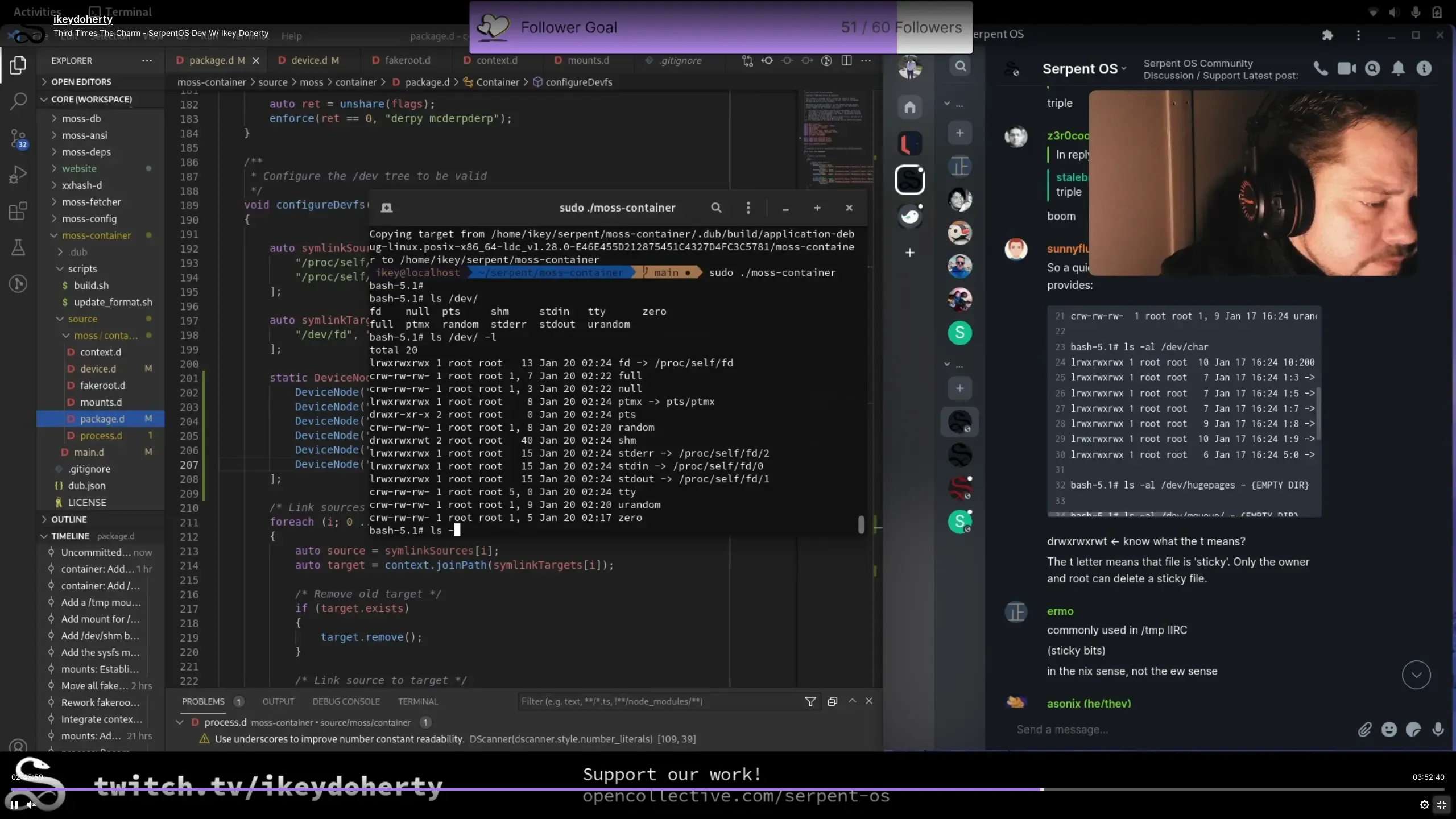
Section titled “Check Out The Development”In case you’ve missed it, ikey has been streaming some of the development of the tooling on his Twitch channel. DLang is not as commonly used as other languages, so check it out to see the advantages it brings. Streams are typically announced on twitter, or give him a follow to see when he next goes live!
Bonus Content Refresh
Section titled “Bonus Content Refresh”This year we’ve had a considerable number of new visitors and interest in Serpent OS. Unfortunately the content on the website had been a bit stale and untouched for some time. There was some confusion and misunderstanding over some of the terms and content. Some of the common issues were:
- Subscriptions is a loaded term relating to software
- Subscriptions only referred to a fraction of the smart features
- Seemed targeted at advanced users with too many technical terms
- Lack of understanding around what moss and boulder do
- That features would add complexity when the tools were actually removing the complexity
The good news is that a good chunk of it has been redone, including two new pages for our core tools boulder and moss. Subscriptions has been renamed to Smart System Management to reflect its broader nature (which you can read about here).
Much of the content has also had a refresh or a rewrite, so if you’ve seen it before, it will likely be a lot easier to digest now. But this isn’t the final state of the content, as more features will need to be added and there’s still a few rough edges (and I like to rewrite things every once in awhile). Many ideas have been raised by our community in the matrix channel1, so a shout-out to the good folks we have hanging out there.
Footnotes
Section titled “Footnotes”-
aerynOS now uses a Zulip server for community discussion. ↩