Skip to content

Blog

Stage2 Complete

Just in case you thought we were sleeping behind the wheel, we’ve got another blogpost for your viewing pleasure. In a nutshell, we completed stage2 bootstrap.
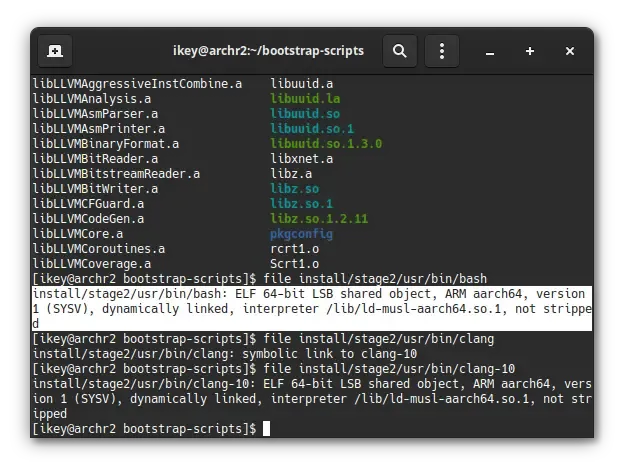
Complete build-target for ARMv8

In order to simplify life, we greatly reduced the size of the stage2 build component. This decision was taken to better support cross-compilation in the face of software that is distinctly cross-compilation unfriendly.

A support stage, stage2.5 will be added which will chroot into a copy of stage2, and natively compile a small handful of packages required to complete stage3, also within the chroot environment.

For cross-compilation, we’ll be relying on qemu-static to complete 2.5 and 3. However, at this point in time, we have the following:

  • Working cross-compilation of the entire bootstrap
  • Complete LLVM based toolchain: clang, llvm, libc++, lib++abi, libunwind
  • Entirety of stage2 built with musl libc.
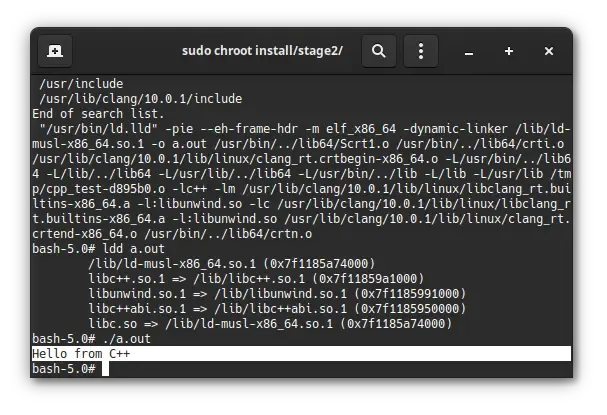
  • Working, minimal, chroot environment as product of stage2, with working compiler (C & C++)

x86_64

This is a major milestone for the project, as it is an early indication that we’re self hosting.
Stage1 Complete

Short and sweet, stage1 of the bootstrap is complete. As I indicated on the Lispy Snake1 blog, I’m still in the process of settling into new accommodation. This is going well, but still awaiting proper broadband connectivity. Work has begun, however, and we’re now moving onto stage2 of the bootstrap.

This is handled via our bootstrap-scripts2 project and can be run by anyone on a relatively modern Linux distribution.

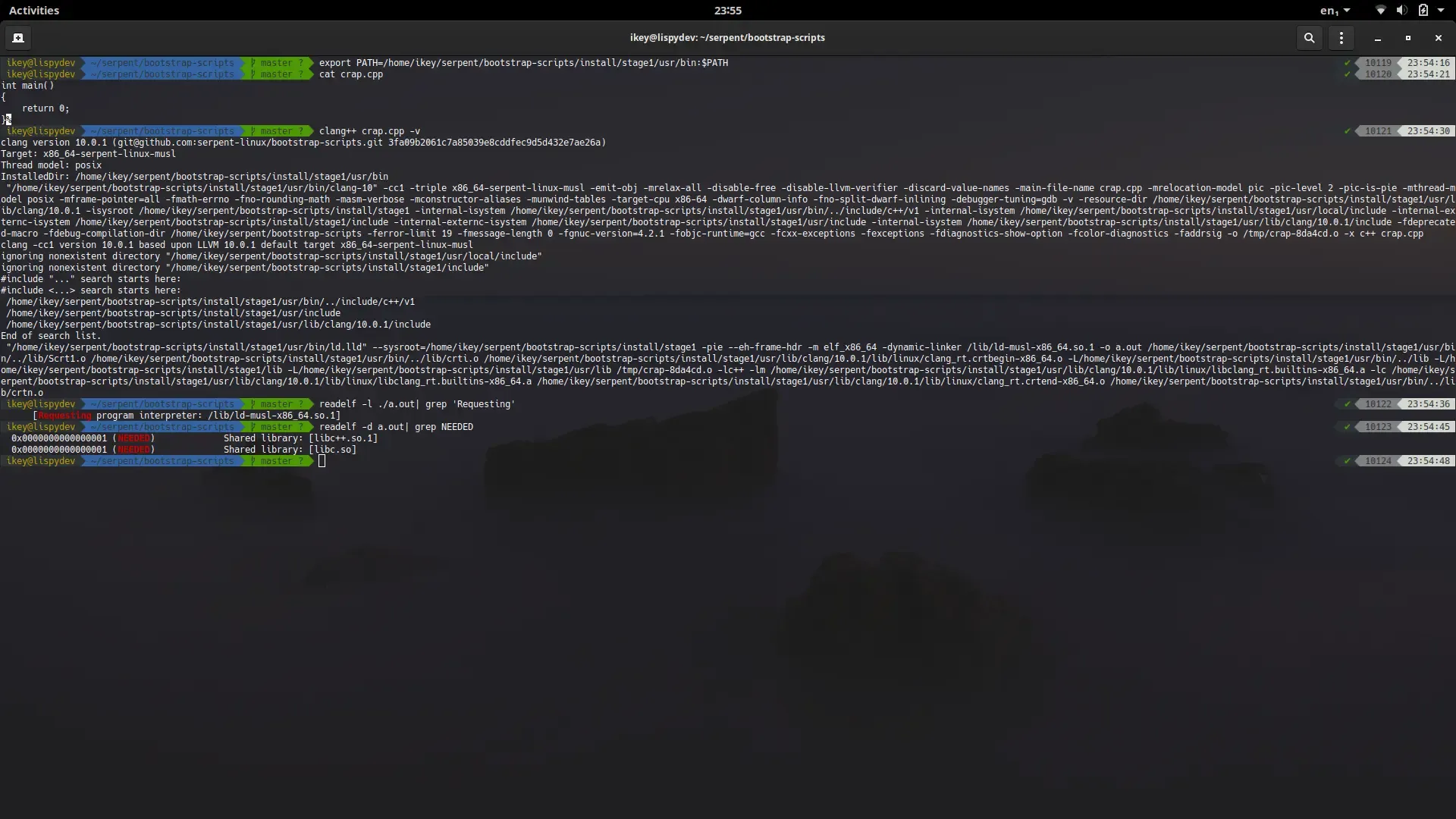
Validating stage1 cross-compiler

Next on the list is completing stage2, which we’ve already started on. This is simply a cross-compiled chroot environment with all the basic bits in place to build stage3, sanitizing and cleansing the toolchain.

Even though it is early days, we can already, automatically produce a working cross-compiler that targets LLVM’s libc++, the musl libc.so, and x86_64-serpent-linux-musl host triplet.

Probably a dull update for most, but an update it is.


  1. Since this blog post, the Lipsy Snake website no longer exists. ↩

  2. Since this blog post, the bootstrap-scripts project no longer exists. ↩

Welcome: Project Manager

The Serpent OS team wishes to formally welcome Aydemir Ulaş Şahin to the core team in the primary capacity of Project Manager. Aydemir will help us to coordinate and manage the project goals and infrastructure, being responsible for certain “keys to the kingdom”.

Aydemir has extensive experience with Linux, both as a user and developer, having worked in the media industry for many years. Additionally he will be contributing to the core system, code and packaging.

Our initial trio has been announced, and you can always access information on the current team at the new About page. Now that much of our groundwork has been laid, we can get on with building the project. Check progress at the new Roadmap1 page.


  1. Since this blog post, we have removed our Roadmap page. ↩

Welcome Peter

Recently we did reveal on Twitter that long time friend and colleague-of-many-projects, Peter O’Connor, has formally joined the core team for Serpent OS. Many of you know him as sunnyflunk. He will be working on core toolchain optimisations, benchmarking, and eventually Plasma inclusion.

Peter has long wanted to get the most out of his computing experience, starting from Gentoo back in the 2000’s to ensure there was no wasted resources on features he didn’t use. The desire to over-tinker and use unstable software often led to poor outcomes. While the itch laid dormant for over a decade, it has always been there.

Peter O’Connor (sunnyflunk)

There’s not much about Linux that currently excites me, but I’ve always wanted to see what’s possible with a full LLVM/Clang stack. There’s never been a better time to find out, but it can be difficult to push the envelope when limited with backwards compatibility and supporting older CPU architectures. After experimenting with some tool-chain customisations the chance to test them out more broadly and with a new tool-chain was too hard to pass up. This is the research project I’ve always wanted to undertake and looking forward to using it as my daily driver

We’d like to officially extend our welcome to Peter, as the ramp up gets in place. It should be noted, he is partly to blame for Serpent OS becoming manifest, as the core team got together after discussions on IRC1. He has some fantastic ideas, and is a brilliant distribution engineer with proven success.

As an aside, we’re working on improving the website to incorporate a team page, ready for the third team member reveal.


  1. aerynOS now uses a Zulip server for community discussion. ↩

The Great Experiment

So as many have come to realise, we had to rush out a website super quick yesterday as the cat was already out of the bag. One thing that should also be clarified, is our approach to development.

Primarily (but not exclusively) Serpent OS (future: Serpent Linux) is an endeavour worked on by the Lispy Snake, Ltd1 crew. So we’re all about creating awesome technology and trying to further the playing field.

Serpent OS is not, however, owned by Lispy Snake. It is a contributor-based open source project, with specific roles. Those will be clarified over the coming week, but there is a dedicated Project Manager. Hint: It’s not me.

So, how does an experimental project… measure success? Quite simply - if others adopt our methodologies or technology, we’ve succeeded. We’re really not looking at “number of installs” or “size of userbase” as a metric, as our chief aim is to build technology.

If the experiment is a success, which of course means having tight controls on scope and timescale, then one would assume the primary way to use Serpent OS would be through some downstream repackaging or reconfiguration, i.e. basing upon the project, to meet specific user demand.

This is the heart and soul of all Linux development. Developers should enjoy the involvement and seeing the end result. If we build something more in the end, then that’s a journey we can create together.


  1. Since this blog post, the Lipsy Snake website no longer exists. ↩