Skip to content

Blog

Lift Off

Enough of this “2 years” nonsense. We’re finally ready for lift off. It is with immense pleasure we can finally announce that Serpent OS has transitioned from a promise to a deliverable. Bye bye, phantomware!

featured image

As mentioned, we spent 2 years working on tooling and process. That’s .. well. Kinda dull, honestly. You’re not here for the tooling, you’re here for the OS. To that end I made a decision to accelerate development of the actual Linux distro - and shift development of tooling into a parallel effort.

I deferred final enabling of the infrastructure until January to rectify the chicken/egg scenario whilst allowing us to grow a base of contributors and an actual distro to work with. We’re in a good position with minimal blockers so no concern there.

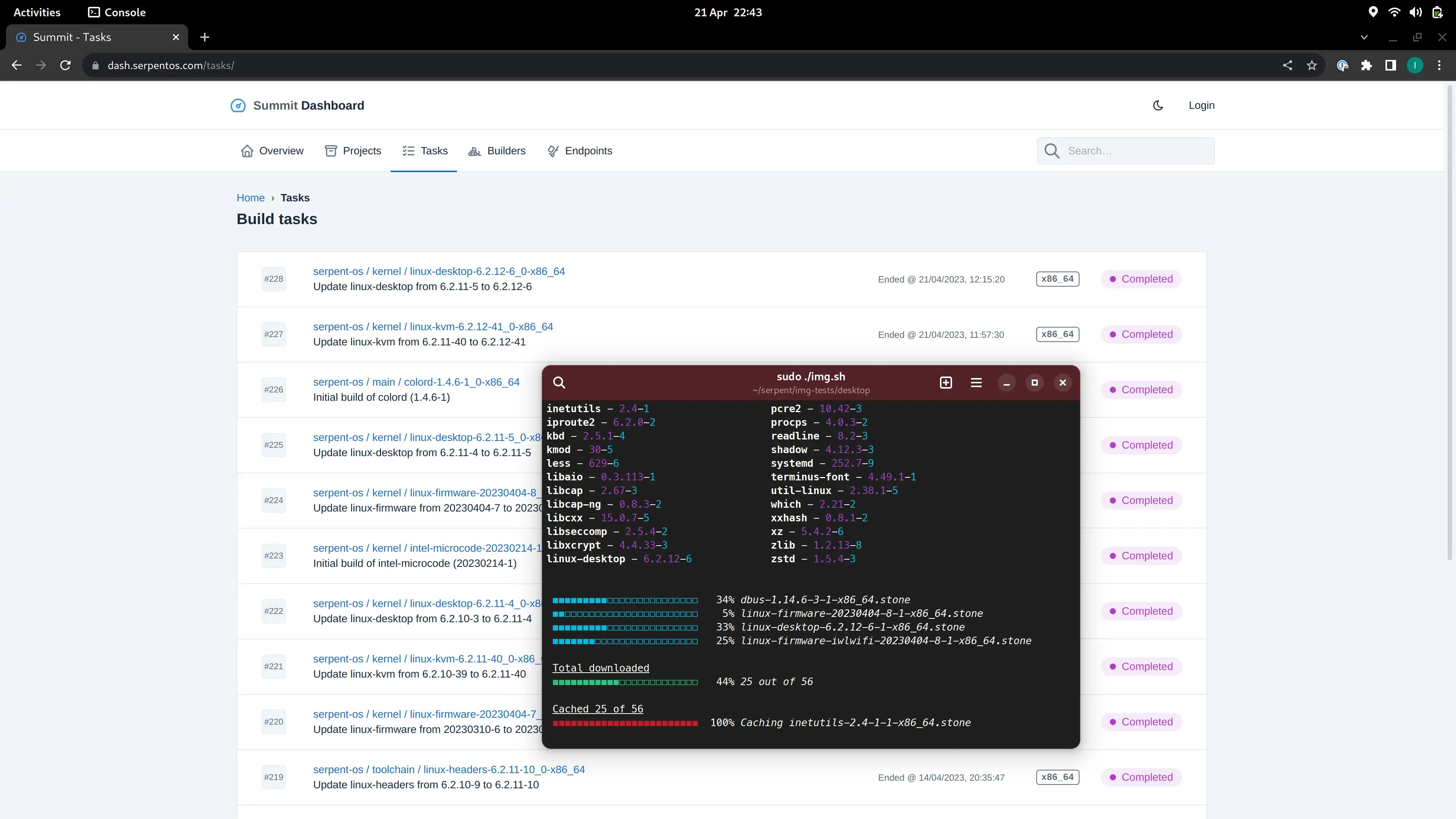
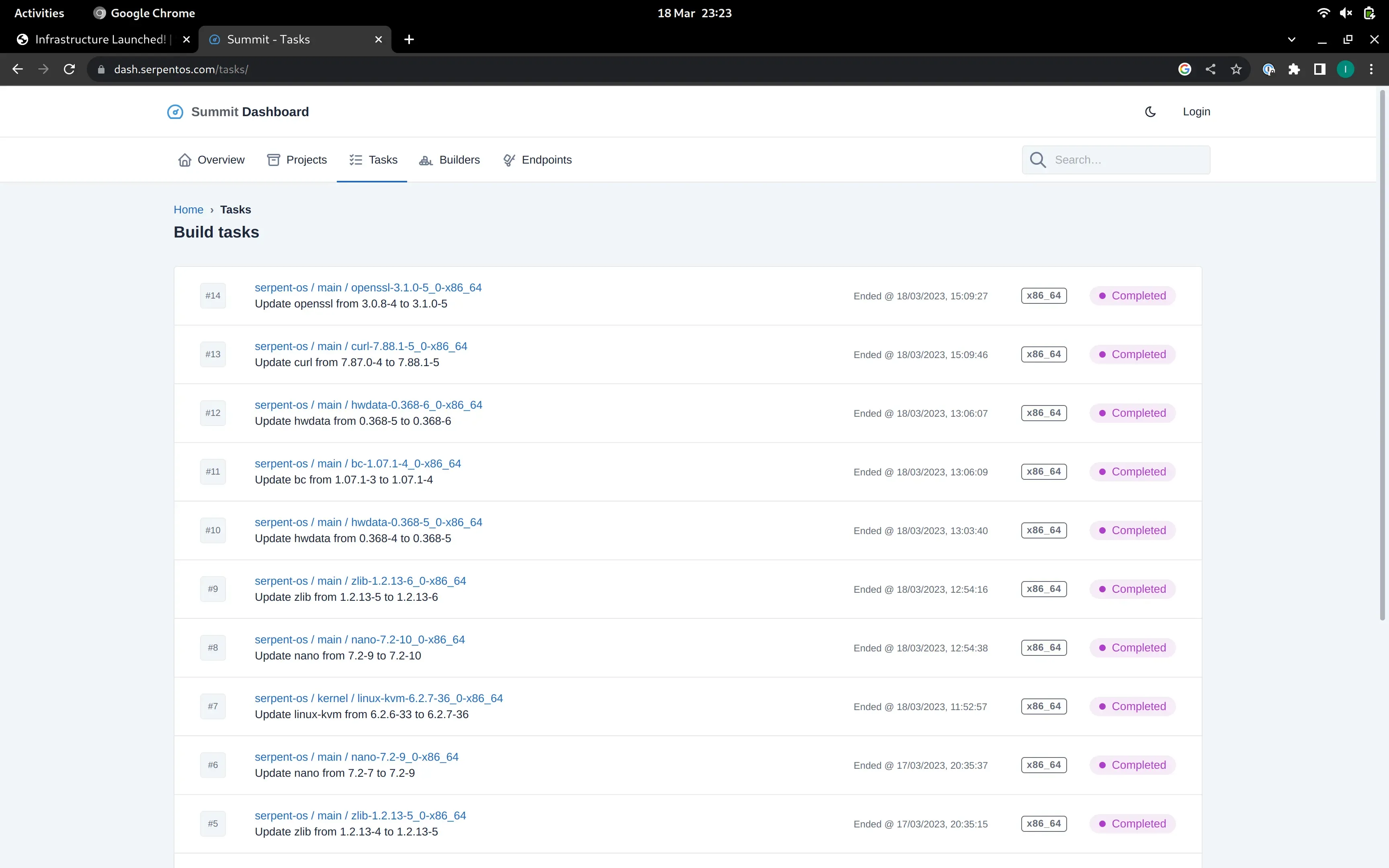
This is our term for the classical “package repository”. We’re using a temporary collection right now to store all of the builds we produce. In keeping with the Avalanche requirements, this is the volatile software collection. Changes a lot, hasn’t got a release policy.

It goes without saying, really, that our project isn’t remotely possible without a community. I want to take the time to personally thank everyone that stepped up to the plate lately and contributed to Serpent OS. Without the work of the team, in which I include the contributors to our venom recipe repository, an ISO was never possible. Additionally contributions to tooling has helped us make significant strides.

It should be noted we’ve practically folded our old “team” concept and ensured we operate across the board as a singular community, with some members having additional responsibilities. Our belief is all in the community have equal share and say. With that said, to the original “team”, members both past and present, I thank for their (long) support and contributions to the project.

We actually went ahead and created our first ISO. OK that’s a lie, this is probably the 20th revision by now. And let’s be brutally honest here:

It sucks.

We expected no less. However, the time is definitely here for us to begin our public iteration, transitioning from suckness to a project worth using. In order to do that, we need to get ourselves to a point whereby we can dogfood our work and build a daily driver. Our focus right now is building out the core technology and packaging to achieve those aims.

So if you want to try our uninstallable, buggy ISO, chiefly created as a brief introduction to our package manager and toolchain, head to our newly minted Download page. Set your expectations low, ignore your dreams, and you will not be disappointed!

All jokes aside, it took a long time to get to point where we could even construct our first, KVM-focused, UEFI-only snekvalidator.iso. We now have a baseline to improve on, a working contribution process, and a booting, self-hosting system.

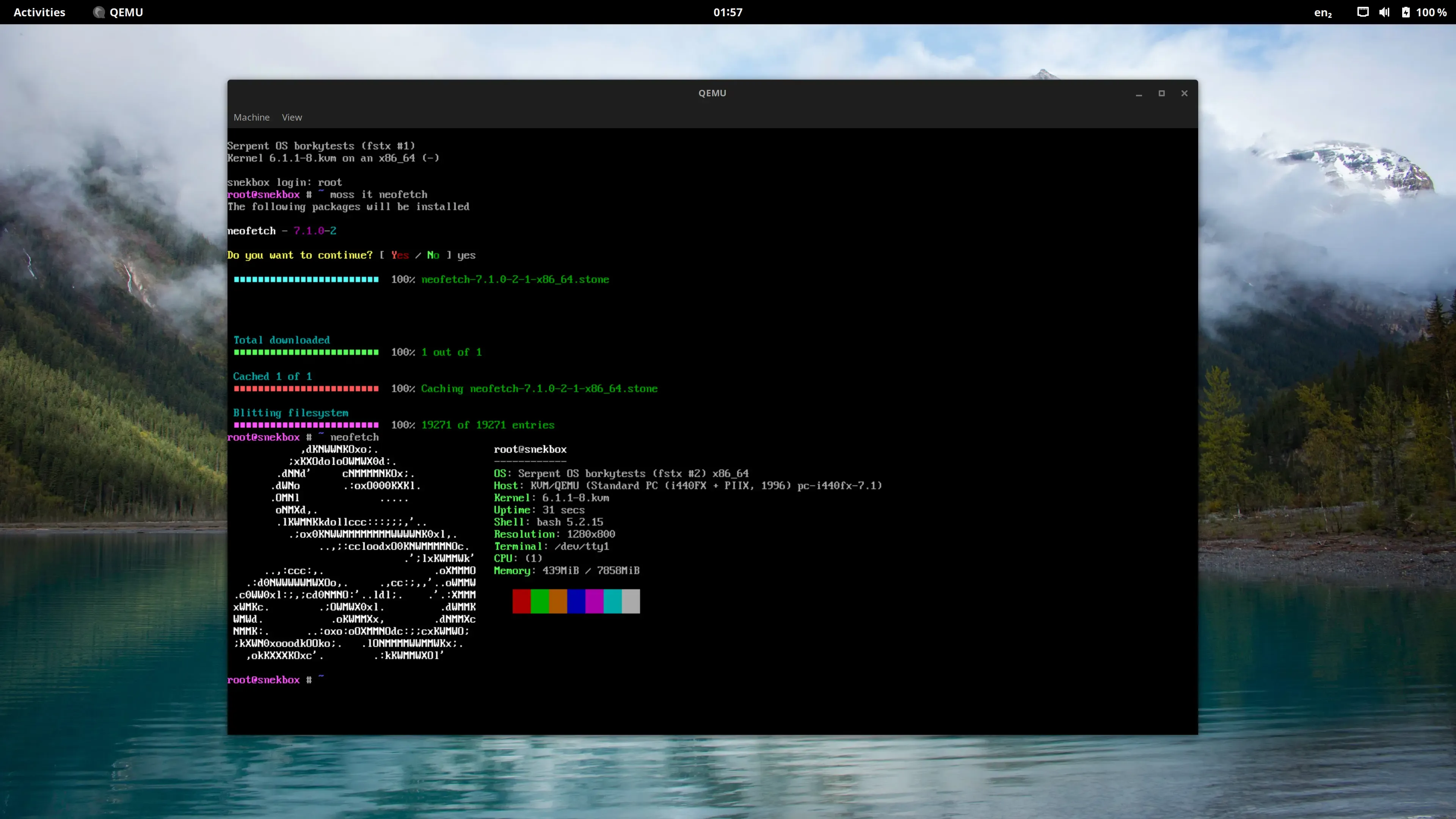
The ISO is built using 2 layered collections, the protosnek collection containing our toolchain, and the new volatile collection. Much of the packaging work has been submitted by venom contributors and the core team. Note you can install neofetch which our very own Rune Morling (ermo) patched to support the Serpent OS logo.

Boot it in Qemu (or certain Intel laptops) and play with moss now! Note, this ISO is not installable, and no upgrade path exists. It is simply the beginnings of a public iteration process.

In January we’ll launch our infrastructure to scale out contributions as well as to permit the mass-rebuilds that need to happen. We have to enable our -dbginfo packages and stripping, which were disabled due to a parallelism issue. We need to introduce our boot management based around systemd-boot, provide more kernels, do hardware enabling, introduce moss-triggers, and much more. However, this is a pivotal moment for our project as we’ve finally become a real, if not sucky, distro. The future is incredibly bright, and we intend to deliver on every one of our promises.

As always, if you want to support our development, please consider sponsoring the work, or engaging with the community on Matrix or indeed our forums.

You can discuss this blog post, or leave feedback on the ISO, over at our forums.

The Big Update

Well - we’ve got some big news! The past few weeks have been an incredibly busy time for us, and we’ve hit some major milestones.

After much deliberation - we’ve decided to pull out of Open Collective. Among other reasons, the fees are simply too high and severely impact the funds available to us. In our early stages, the team consensus is that funds generated are used to compensate my time working on Serpent OS.

As such I’m now moving funding to my own GitHub Sponsors page - please do migrate! It ensures your entire donation makes it and keeps the lights on for longer =) Please remember I’m working full time on Serpent OS exclusively - I need your help to keep working.

We’ve pretty much completed our transition to GitHub. We’ve now got the following organisations:

Don’t forget - our forums are live over at forums.serpentos.com - please feel free to drop in and join in with the community =)

OK so what exactly are moss and boulder? In short - they’re the absolute core pieces of our distribution model.

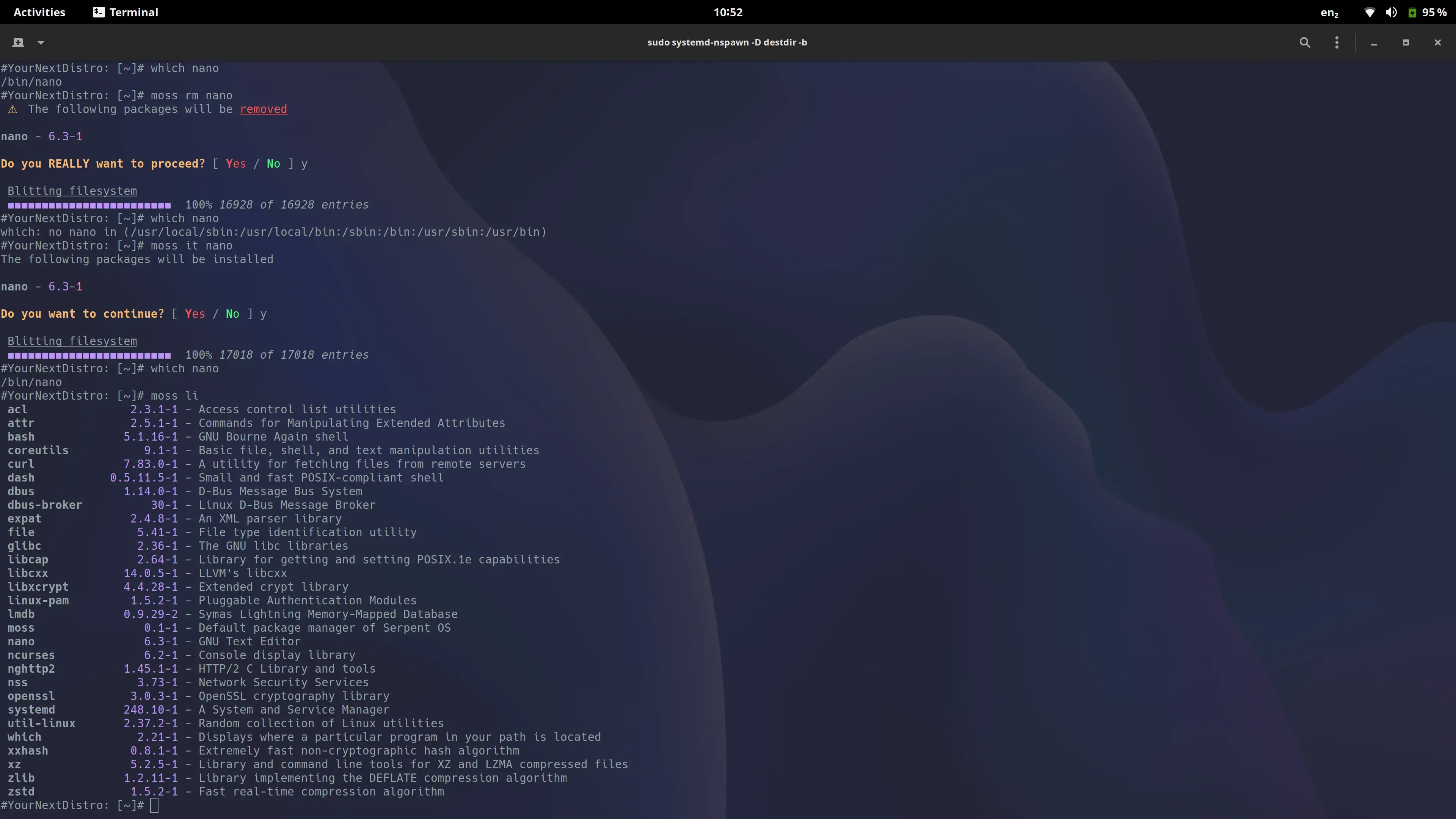
On the surface, moss looks and feels roughly the same as just about any other traditional package manager out there. Internally, however, its far more modern and has a few tricks up its sleeve. For instance, every time you initiate an operation in moss, be it installation, removal, upgrade, etc, a new filesystem transaction is generated. In short, if something is wrong with the new transaction - you can just boot to an older transaction when things worked fine.

Now, it’s not implemented using bundles or filesystem specific functionality, internally its just intelligent use of hardlinks and deduplication policies, and we have our own container format with zstd based payload compression. Our strongly typed, deduplicating binary format is what powers moss.

Behind the scenes we also use some other cool technology, such as LMDB for super reliable and speedy database access. The net result is a next generation package management solution that offers all the benefits of traditional package managers (i.e. granularity and composition) with new world features, like atomic updates, deduplication, and repository snapshots.

It’s one thing to manage and install packages, it’s another entirely to build them. boulder builds conceptually on prior art such as pisi and the package.yml format used in ypkg. It is designed with automation and ease of integration in mind, i.e. less time spent focusing on packaging and more time on actually getting the thing building and installing correctly.

Boulder supports “macros” as seen in the RPM and ypkg world, to support consistent builds and integration. Additionally it automatically splits up packages into the appropriate subpackages, and automatically scans for binary, pkgconfig, perl and other dependencies during source analysis and build time. The end result is some .stone binary packages and a build manifest, which we use to flesh out our source package index.

We’ve spent considerable time reworking moss, our package manager. It now features a fresher (terminal) user interface, progress bars, and is rewritten to use the moss-db module encapsulating LMDB.

nspawn

It’s also possible to manipulate the binary collections (software repositories) used by moss now. Note we’re going to rename “remote” to “collection” for consistency.

At the time of writing:

Terminal window
$ mkdir destdir
$ sudo moss remote add -D destdir protosnek https://dev.serpentos.com/protosnek/x86_64/stone.index
$ sudo moss install -D destdir bash dash dbus dbus-broker systemd coreutils util-linux which moss nano
$ sudo systemd-nspawn -b -D destdir

This will be simplified once we introduce virtual packages (Coming Soon ™)

Boulder can now be instructed to utilise a local collection of stone packages, simplifying the development of large stack items.

Terminal window
sudo boulder bi stone.yml -p local-x86_64

Packages should be moved to /var/cache/boulder/collections/local-x86_64 and the index can be updated by running:

Terminal window
sudo moss idx /var/cache/boulder/collections/local-x86_64

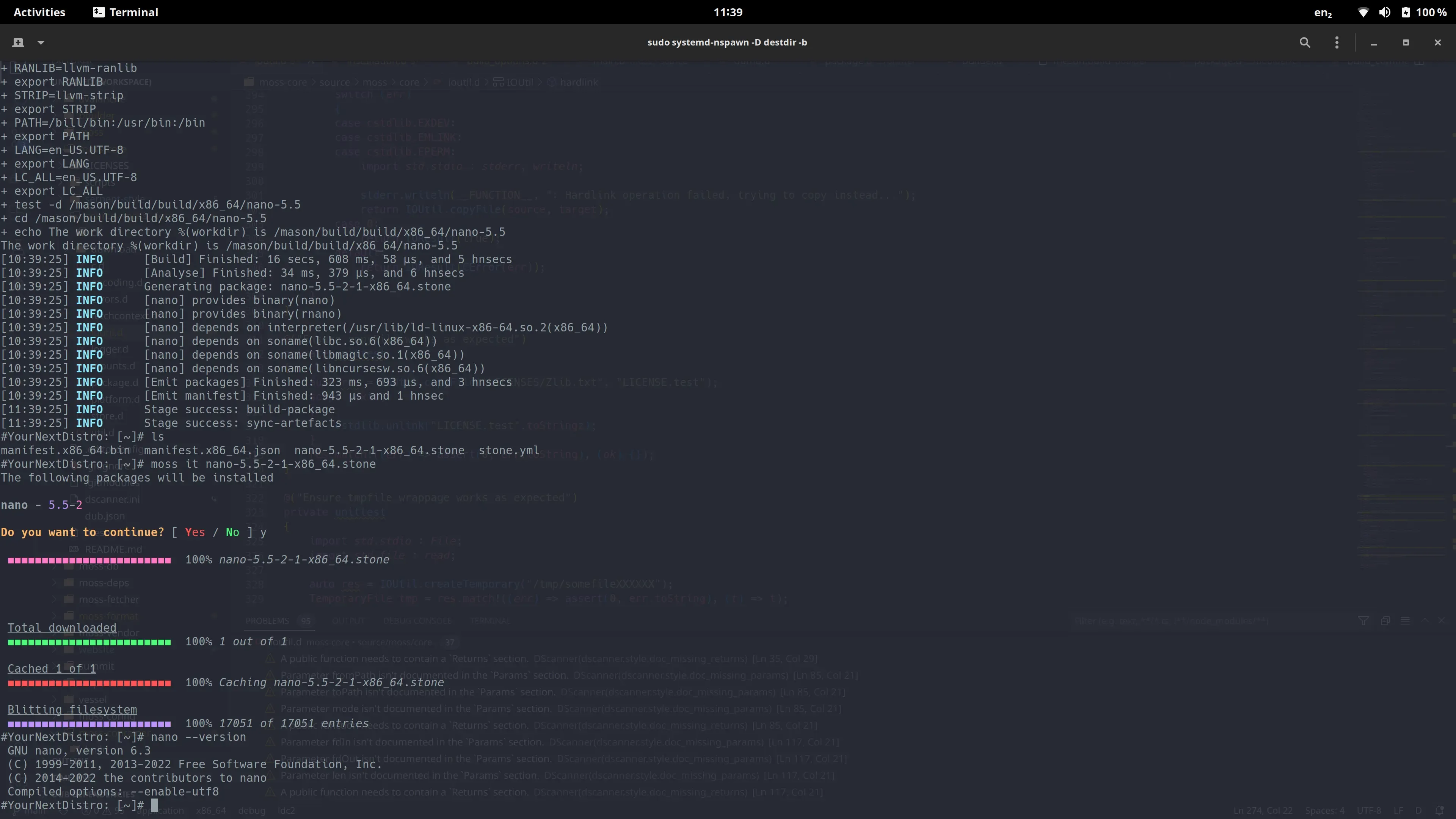
Serpent OS is now officially self hosting. Using our own packages, we’re able to construct a root filesystem, then within that rootfs container we can use our own build tooling (boulder) to construct new builds of our packages in a nested container.

The protosnek collection has been updated to include the newest versions of moss and boulder.

self hosting

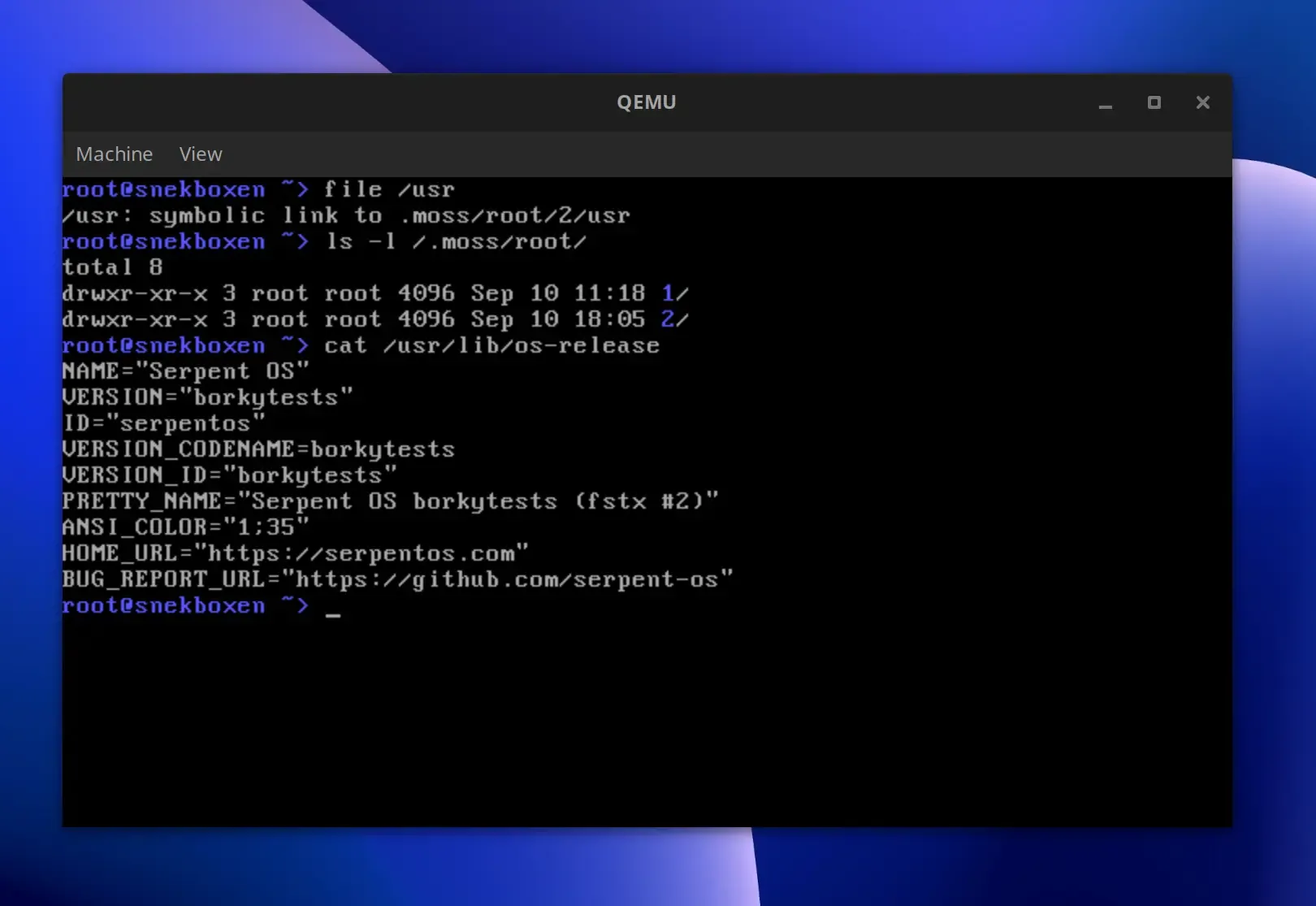
As a fun experiment, we wanted to see how far along things are. Using a throwaway kernel + initrd build, we were able to get Serpent OS booting using virtualisation (qemu)

booting

Right now everyone is working in the snekpit organisation to get our base packaging in order. I’m looking to freeze protosnek, our bootstrap collection, at the latest of tomorrow evening.

We now support layered, priority based collections (repositories) and dependency solving across collection boundaries, allowing us to build our new main collection with protosnek acting as a bootstrap seed.

Throughout this week, I’ll focus on getting Avalanche, Summit and Vessel into shape for PoC so that we can enjoy automated builds of packages landing in the yet-to-be-launched volatile collection.

From there, we’re going to iterate + improve packaging, fixing bugs and landing features as we discover the issues. Initially we’ll look to integrate triggers in a stateless-friendly fashion (our packages can only ship /usr by design) - after that will come boot management.

An early target will be Qemu support via a stripped linux-kvm package to accelerate the bring up, and we encourage everyone to join in the testing. We’re self hosting, we know how to boot, and now we’re able to bring the awesome.

I cannot stress how important the support to the project is. Without it - I’m unable to work full time on the project. Please consider supporting my development work via GitHub Sponsors.

I’m so broke they’ve started naming black holes after my IBAN.

Thank you!

You can discuss this blog post over on our forums

Infrastructure Update

Since the last post, I’ve pivoted to full time work on Serpent OS, which is made all the more possible thanks to everyone supporting us via OpenCollective <3.

We’ve been working towards establishing an online infrastructure to support the automation of package builds, while revisiting some core components.

During the development of the Serpent OS tooling we’ve been exploring the possibilities of D Lang, picking up new practices and refining our approach as we go. Naturally, some of our older modules are somewhat … smelly. Most noticeable is our moss-db module, which was initially intended as a lightweight wrapper around RocksDB.

In practice that required an encapsulation API written in D around the C API, and our own wrapping on top of that. Naturally, it resulted in a very allocation-heavy implementation that just didn’t sit right with us, and due to the absurd complexity of RocksDB was still missing quite a few features.

We’re now using the Lightning Memory-Mapped Database as the driver implementation for moss-db. In short, we get rapid reads, ACID transactions, bulk inserts, you name it. Our implementation takes advantage of multiple database indexes (MDB_dbi) in LMDB to partition the database into internal components, so that we can provide “buckets”, or collections. These internal DBs are used for bucket mapping to permit a key-compaction strategy - iteration of top level buckets and key-value pairs within a bucket.

The majority of the API was designed with the boltdb API in mind. Additionally it was built with -preview=dip1000 and -preview=in enabled, ensuring safely scoped memory use and no room for memory lifetime issues. While we prefer the use of generics, the API is built with immutable(ubyte[]) as the internal key and value type.

Custom types can simply implement mossEncode or mossDecode to be instantly serialisable into the database as keys, values or bucket identifiers.

Example API usage:

Database db;
/* setup the DB with lmdb:// URI */
/* Write transaction */
auto err = db.update((scope tx) @safe
{
auto bucket = tx.bucket("letters");
return tx.set(bucket, "a", 1);
});
/* do something with the error */
err = db.view((in tx) @safe
{
foreach (name, bucket ; tx.buckets!int)
{
foreach (key, value ; tx.iterator!(string,string)(bucket))
{
/* do something with the key value pairs, decoded as strings */
}
}
/* WILL NOT COMPILE. tx is const scope ref :) */
tx.removeBucket("numbers");
return NoDatabaseError;
}

Moss will be ported to the new DB API and we’ll gather some performance metrics, while implementing features like expired state garbage collection (disk cleanup), searching for names/descriptions, etc.

Early version of avalanche, in development

Avalanche is a core component of our upcoming infrastructure, providing the service for running builds on a local node, and a controller to coordinate a group of builders.

Summit will be the publicly accessible project dashboard, and will be responsible for coordinating incoming builds to Avalanche controllers and repositories. Developers will submit builds to Summit and have them dispatched correctly.

So far we have the core service process in place for the Controller + Node, and now we’re working on persistence and handshake. TLDR; fancy use of moss-db and JSON Web tokens over mandated SSL. This means our build infra will be scalable from day 1 allowing multiple builders to be online very early on.

We’re planning to get an early version of our infrastructure up and running within the next 2 weeks, and get builds flowing =)

Packaging Automation, Next Steps

Hot damn we’ve been busy lately. No, really. The latest development cycle saw us focus exclusively on boulder, our build tooling. As of today it features a proof of concept boulder new subcommand for the automatic generation of packaging templates from an upstream source (i.e. tarball).

Before we really start this blog post off, I’d like to thank everyone who is supporting the project! All of the OpenCollective contributions will make it easier for me to work full time on Serpent OS =) Much love <3

Look at all the buildiness

Alright you got me there, certain projects prefer to abstract the configuration, build and installation of packages and be provided with some kind of hint to the build system, i.e. manually setting autotools, etc.

Serpent OS packaging is declarative and well structured, and relies on the use of RPM-style “macros” for distribution integration and common tasks to ensure consistent packaging.

We prefer a self documenting approach that can be machine validated rather than depending on introspection at the time of build. Our stone.yml format is very flexible and powerful, with automatic runtime dependencies and package splitting as standard.

..Doesn’t mean we can’t make packaging even easier though.

Pointing boulder at an upstream source will perform a deep analysis of the sources to determine the build system type, build dependencies, metadata, licensing etc. Right now it’s just getting ready to leave POC stage so it has a few warts, however it does have support for generating package skeletons for the following build systems:

  • cmake
  • meson
  • autotools

We’re adding automation for Perl and Python packaging (and Golang, Rust, etc) so we can enforce consistency, integration and ease without being a burden on developers. This will greatly reduce the friction of contribution - allowing anyone to package for Serpent OS.

We’re also able to automatically discover build time dependencies during analysis and add those to the skeleton stone.yml file. We’ll enhance support for other build systems as we go, ensuring that each new package is as close to done on creation as possible, with review and iteration left to the developer.

A common pain in the arse when packaging for any Linux distribution is ensuring the package information is compliant in terms of licensing. As such we must know all of the licensing information, as well as FSF and OSI compliance for our continuous integration testing.

…Finding all of that information is truly a painful process when conducted manually. Thankfully boulder can perform analysis of all licensing files within the project to greatly improve compliance and packaging.

Every license listed in a stone.yml file must use a valid SPDX identifier, and be accurate. boulder now scans all license files, looking for matches with both SPDX IDs as well as fuzzy-matching the text of input licenses to make a best-guess at the license ID.

This has so far been highly accurate and correctly identifies many hundreds of licenses, ensuring a compliant packaging process with less pain for the developers. Over time we’ll optimise and improve this process to ensure compliance for our developers rather than blocking them.

As of today we support the REUSE specification for expressing software licenses too!

The next steps are honest-to-goodness exciting for us. Or should I say.. exiting?

Work formally begins now on Bootstrap Bill (Turner). Whilst we did successfully bootstrap Serpent OS and construct the Protosnek repository, the process for that is not reproducible as boulder has gone through massive changes in this time.

The new project will leverage boulder and a newly designed bootstrap process to eliminate all host contamination and bootstrap Serpent OS from stone.yml files, emitting an immutable bootstrap repository.

Layering support will land in moss and boulder to begin the infrastructure projects.

The aim is to complete bill in a very short time so we can bring some initial infrastructure online to facilitate the automatic build of submitted build jobs. We’ll use this process to create our live repository, replacing the initial bootstrap repository from bill.

At this point all of the tooling we have will come together to allow us all to very quickly iterate on packaging, polish up moss and race towards installed systems with online updates.

A Word From The Founder

Well well, it’s been a long time since I personally wrote a post.. :) So let’s keep this short and sweet, shall we? I’m returning to full time work on Serpent OS.

The 6th of July will be my last day at my current employment having tendered my 30 day notice today. Despite having enjoyment at my current position, the reality is that my passion and focus is Serpent OS.

I’m now in a transition process and will ramp up my efforts with Serpent OS. Realistically I need to reduce the outgoing costs of the project and with your help I can gain some level of financial support as we move through the next stages of development. Worst case, I will only take on any part-time or contractual gigs, allowing my primary focus to be Serpent OS.

I’ll begin accelerating works and enabling community contribution so we can get the derailed-alpha train back on the tracks.

I have absolute faith in this project, the community and our shared ability to deliver the OS and tooling. To achieve it will require far more of my time and I’m perfectly willing to give it.

Thank you all to everyone who has been supporting the project, it is now time to deliver. Not just another run of the mill distribution but a technically competent and usable distribution that is not only different but better.

Let’s do this in the most grassroots and enjoyable way possible =)